
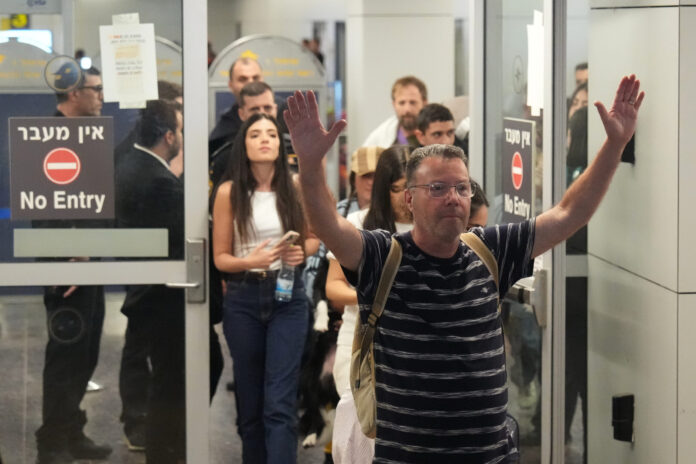
JERUSALEM (AP) — Israel is renowned for its rigorous air travel security protocols, while the United Arab Emirates takes pride in adhering to international standards of aviation safety. However, these protective measures failed to avert a potentially catastrophic incident during a flight between the two nations when an alleged cockpit attack occurred.
During FlyDubai Flight FZ1073, which was en route from Dubai, UAE to Tel Aviv, Israel, the copilot reportedly attacked the captain with a knife before passengers stepped in to assist. The flight, carrying 174 individuals, had just taken off on Wednesday when the incident occurred.
The aircraft successfully executed an emergency landing in Saudi Arabia on the same day, and an investigation is now underway. Authorities from Saudi Arabia, the UAE, and Israel are collaborating, with support from the United States and Oman to uncover the motives behind this attack.
“Until this incident, the likelihood of a threat originating from a member of the flight crew was not something we considered probable. Our security measures have mainly focused on passengers and their belongings,” remarked Eyal Hulata, Israel’s former national security adviser. “This perspective will likely shift, resulting in crew members undergoing more rigorous screening in the future.”
While Israel’s security operations primarily emphasize national airlines and flights departing from Ben-Gurion International Airport, the situation abroad presents challenges, as the regulatory procedures for flights to Israel can be inconsistent and less monitored by Israeli officials.
Dubai International Airport is recognized as the busiest airport globally for international passenger traffic. Its reputation for safety in a tumultuous region plays a significant role in its appeal, according to Philip Baum, a visiting aviation security professor at Coventry University in England.
“Like Israel, they are very aware that they cannot afford a terrorist attack originating from a flight departing from their airport,” he stated.
Pilot Vetting and Preflight Screening Not Consistent Globally
As of now, investigators have not disclosed the item used in the attack on the captain or confirmed whether it was brought on board by the copilot or obtained from within the aircraft itself.
According to Dave Komendat, a senior security adviser at International SOS and former chief security officer for Boeing, preflight screening for flight crews should closely resemble the process passengers undergo. However, security procedures differ significantly across countries.
On Thursday, Prime Minister Benjamin Netanyahu highlighted Israel’s long-standing agreements with international carriers, which prevent pilots from flying into Israel if they come from nations lacking diplomatic relations with Israel.
Israeli officials have identified the FlyDubai copilot as Omani. Given that Israel and Oman do not share formal diplomatic ties, this raises concerns about how the individual was permitted on the flight bound for Tel Aviv.
“Clearly, there was a breach in security, and we are addressing it,” Netanyahu stated during an interview on Fox News Channel’s “Fox and Friends.”
The International Civil Aviation Organization establishes fundamental standards for pilot vetting and licensing, but additional requirements can be set by national regulators and airlines.
Aviation security specialist Menachem Bachrach remarked that Israel primarily depends on foreign governments and airlines for the vetting of their crew members. He noted that this incident may indicate a failure in compliance rather than a gap in the actual security procedures.
“Before imposing stricter security measures, it may be worthwhile to determine whether there was a failure to adhere to existing protocols,” Bachrach suggested.
Investigators to Examine Red Flags and Distress Call Responses
El Al, Israel’s flag carrier, routinely evaluates the fitness of its pilots, while other airlines may be less vigilant in this area, according to Arik Arad, chairman of the aviation cybersecurity consultancy CYVIATION and former head of security at Ben Gurion Airport.
Usually, flight crews undergo preemployment screenings, drug testing, and consistent medical assessments, Komendat added. Investigators will seek to establish if any colleagues had raised concerns about the copilot beforehand, as well as how the airline responded to those concerns.
Both UAE and Israeli investigators will likely scrutinize the responses to the distress calls made by the FlyDubai flight following a drop in altitude.
One individual who listened to the aircraft’s communications with air traffic control stated that a crew member reported a hijacking and requested ambulances. Initially, authorities in Saudi Arabia and Jordan refused to allow the plane to land, according to the source, who spoke on condition of anonymity due to lack of authorization to share information with the media.
Ultimately, the crew member was able to secure permission from Saudi officials for the aircraft to safely land at Prince Sultan bin Abdulaziz International Airport in Tabuk.
International standards urge countries to provide maximum assistance to aircraft facing hijacking or other forms of unlawful interference. However, according to the 1944 Convention on International Civil Aviation, countries are only required to extend assistance “as it may find practicable,” which leads to what has been characterized as a “soft obligation,” said Vincent Correia, co-director of McGill University’s Institute of Air and Space Law.
In practical terms, the guidance provided by the International Civil Aviation Organization regarding hijacked aircraft may conflict with each nation’s interests, noted Justin Green, a New York attorney specializing in international aviation law.
“Every nation operates under its own sovereignty and is tasked with determining protocols for its airspace and airports, which can sometimes prioritize their security concerns over the safety of passengers and crew members aboard an aircraft,” Green explained. “Given the current conflict, countries in the region are likely on heightened alert, which may have influenced their initial hesitance to allow the aircraft to land.”
Standard procedure during serious emergencies is to land an aircraft as soon as possible at the nearest viable runway, regardless of the nationality, flight path, or political situations involved, stated John Gradek, who manages McGill’s Aviation Management Program.
Gradek emphasized that the reasoning behind the FlyDubai plane’s decision to take a 180-degree turn as it entered Jordanian airspace before changing course towards Tabuk remains uncertain. He mentioned that it is not uncommon for flight crews to bypass the nearest airport in favor of one better suited to their circumstances.
Secure Cockpits Central to Flight Security for 25 Years
Netanyahu stated that the injured captain played a crucial role in saving the aircraft and the 182 individuals on board by resisting the copilot’s assaults long enough to unlock the cockpit door. This action allowed passengers to subdue the suspect, while other crew members regained control of the airplane.
Following the September 11, 2001, attacks, cockpit doors worldwide were fortified and locked to deter intruders. The FlyDubai incident, along with other previous cases related to pilot-induced crashes, emphasizes the potential dangers posed by threats originating from within the cockpit.
“The aviation sector must acknowledge that, while cockpit doors were fortified to prevent suicidal hijacks by passengers, they now create a fortress that legitimate crew members cannot access in instances of a rogue individual, like an intruder or errant crew member,” Baum commented.
Experts within the airline industry possess extensive knowledge regarding security vulnerabilities and can earn the trust of security personnel they frequently encounter, stated Matthew Borie, Chief Intelligence Officer of Osprey Flight Solutions, a company that provides advice to airlines about flight-related threats.
“If an insider harbors malicious intentions, they are often the best equipped to identify and exploit the weakest points in the security framework,” Borie added.
___
Yamat reported from Las Vegas, Nevada, while Marcel reported from New York. Contributions to this report were also made by Jill Lawless in London, Sam Mednick in Tel Aviv, Israel, and Josh Funk in Omaha, Nebraska.