
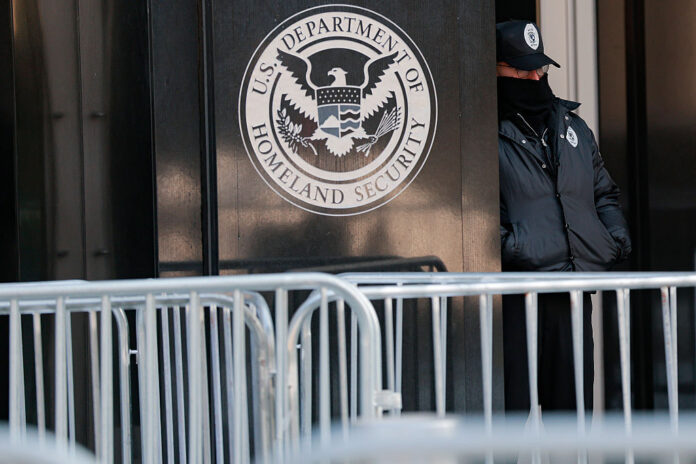
According to a report released by the Department of Homeland Security’s (DHS) Office of Inspector General, agents with Homeland Security Investigations (HSI) reported a heightened focus on immigration enforcement that commenced in January 2025.
This article was republished with permission from WTOP’s news partners at Maryland Matters. Read the story at Maryland Matters.
WASHINGTON — A new report indicates that fentanyl seizures fell by 39% in the first year of the second Trump administration. This decline followed U.S. Immigration and Customs Enforcement’s decision to prioritize immigration enforcement over the Department of Homeland Security’s criminal investigations division, the report revealed on Friday.
The report from the DHS Office of Inspector General highlighted that agents within Homeland Security Investigations, a division of U.S. Immigration and Customs Enforcement (ICE), described an “all hands-on deck” mentality regarding immigration enforcement that took effect in January 2025.
The findings indicate that as ICE allocated more staff hours to immigration cases, the time allotted for fentanyl investigations saw a corresponding reduction. Specifically, there was a decline of over 250,000 hours, marking a 31% decrease in hours dedicated to fentanyl investigations for fiscal year 2025, compared to fiscal year 2024.
Conversely, the report noted that immigration enforcement experienced a dramatic increase, gaining more than 1.7 million hours, which translates to an over 800% rise across all investigation categories.
To compile the report, inspectors spoke with more than 100 agents from 11 HSI field offices.
At one HSI office, nearly 99% of the workload was focused on immigration enforcement, leaving little room for fentanyl-related investigations. The division’s drug investigation team, which originally comprised seven agents, was reduced to just about three, as most personnel were reassigned to handle immigration cases, as outlined in the report.
Fentanyl, a powerful synthetic opioid, is identified as the primary cause of overdose deaths in the United States. HSI plays a crucial role in combatting fentanyl trafficking in the country by targeting smuggling routes, production laboratories, and collaborating with law enforcement agencies to investigate trafficking operations.
ICE’s Response
The inspector general’s report recommended that HSI assess its staffing levels “to guarantee an adequate level of coverage in relation to the significance of fentanyl investigations.”
Before publication, inspector general reports are shared with the relevant agency for feedback, and ICE acknowledged the recommendations made in the DHS OIG report.
“Homeland Security Investigations will evaluate staffing levels and determine necessary next steps to ensure appropriate coverage in line with the importance of fentanyl investigations,” ICE stated in its response to the report.
ICE anticipates that the implementation of this recommendation will be finalized by June 2027.
Additionally, the report underscored that the technology utilized by HSI agents and analysts during fentanyl investigations had limitations. Their efforts were further obstructed by delays in securing funds for obtaining information and evidence (such as drugs) needed for investigations, a lack of independent authority to pursue fentanyl-related offenses, and inconsistent referrals of fentanyl cases from U.S. Customs and Border Protection to HSI.