
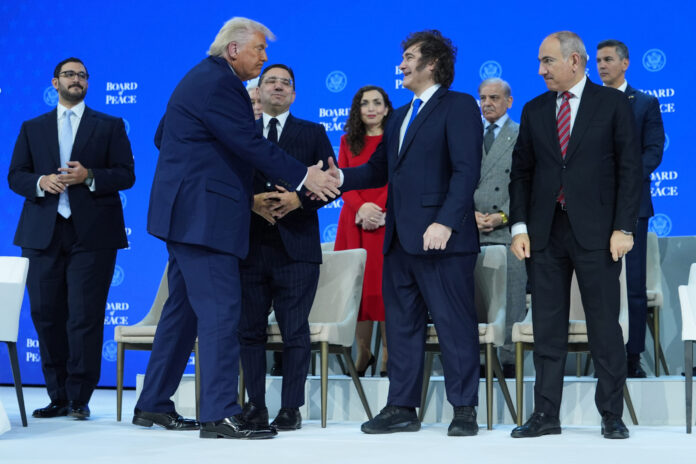
BUENOS AIRES, Argentina (AP) — On Wednesday, the Trump administration announced it would allocate $7 billion in loans aimed at bolstering energy, mining, and infrastructure development within Argentina. This move constitutes the latest strategy to secure energy and vital minerals more locally and to support the country’s libertarian president.
The U.S. Export-Import Bank, a government agency, will offer up to $7 billion in available funding through 2027 specifically for projects in Argentina. The State Department indicated that these loans would assist domestic companies in acquiring American equipment and employing U.S. firms for the enhancement of the nation’s railways, pipelines, ports, and power infrastructure.
This agreement represents a continuation of U.S. President Donald Trump’s initiative to lessen dependency on China’s mineral processing sector. Additionally, it seeks to fortify the position of Trump’s ally, President Javier Milei. Milei is optimistic that a focus on oil, gas, and mineral exports will revitalize Argentina’s economy while addressing persistent dollar shortages that have led to recurrent financial crises.
In a statement, the State Department affirmed, “Through collaboration, the United States and Argentina are committed to strengthening our meaningful relationship, fostering increased U.S. investment, enhancing security cooperation, and upholding shared values.”
The partnership has already started to yield benefits for Milei’s administration. Previously, Washington provided significant backing for a $20 billion International Monetary Fund bailout to Argentina and established a $20 billion currency-swap line to support the Argentine peso. Additionally, a free trade agreement was signed earlier in the year.
During the U.N. General Assembly in New York, U.S. Deputy Secretary of State Christopher Landau and Argentine Foreign Minister Pablo Quirno highlighted this agreement, which aims to connect the mineral-rich northwest of Argentina, including significant lithium and copper deposits as well as the expansive Vaca Muerta shale fields, to the country’s ports. This will facilitate the export of minerals, oil, and gas to the United States and other international markets.
Historically, underdeveloped transport and energy infrastructure has hindered the exploitation of Argentina’s remote mineral resources. The country has faced numerous challenges, including protectionist trade practices, currency controls, and defaults on sovereign debt, all of which have deterred foreign investment.
President Milei, a staunch advocate for free-market principles, has been working to liberalize the Argentine economy by removing import restrictions and providing tax incentives to attract investment. While these policies have resulted in a boom of inexpensive imports, they have also pressured labor-dependent sectors such as manufacturing and retail, which were already grappling with challenges from austerity measures and restrictive monetary policies. As a result, the surging oil production and mining exports have become essential for the nation’s economic survival.
Argentina is rich in vast lithium and copper deposits, which are critical for supporting the global transition to green energy.