
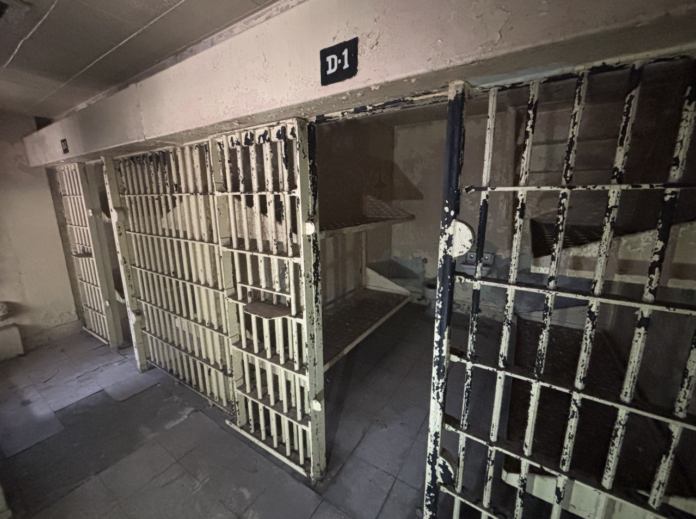
OLD ELLICOTT CITY, Md. — The historic granite jail located on Emory Street has remained unoccupied for almost twenty years, but that situation is on the verge of changing.
On Thursday, Howard County Executive Calvin Ball officially transferred the lease of the Old Ellicott City jail to Preservation Maryland, a non-profit organization that is spearheading efforts to repurpose the facility.
This initiative has been in the works for several years.
“The county indicated that if there was community involvement, support, and sufficient fundraising, then they would enter discussions,” said Laura Houston, director of revitalization initiatives at Preservation Maryland.
Through their efforts, they successfully raised $4 million, aided in part by contributions from the county. Now, the project is one significant step closer to realization.
The task of preserving the history tied to this 150-year-old jail, known for its notorious past, is a serious one, a responsibility that Houston embraces wholeheartedly.
“Our aim is to be responsible stewards not only of the physical structure but also of the narratives it embodies,” she explained. “To preserve a site… it connects you to the people of the past and encourages humanity within ourselves.”
In pursuit of their mission, they have forged partnerships with various partners including the county, the University of Maryland School of Architecture, Planning and Preservation, as well as the Maryland Lynching Truth and Reconciliation Commission, among others.
The jail carries a dark and troubling history. It was once a holding area for enslaved individuals seeking liberation and those who assisted them. It also bears a history of lynchings. Conditions within the facility were so poor that, according to Houston, congressional efforts were made to improve it in the 1940s.
“It was often described as dark, damp, and unsanitary. Inmates would request to be transferred to Baltimore or any facility other than the jail in Ellicott City,” Houston noted.
Finding a way to acknowledge this painful history while also looking forward to a hopeful future is delicate yet essential.
The plan is to convert the jail into a community space that will host various activities, welcome University of Maryland students, and act as the new headquarters for the non-profit organization.
Some elements of the original construction, such as the jail cells, will be preserved as reminders of both the building’s past and the individuals who were once confined there.
WMAR-2 News (Blair Sabol)
“This long-abandoned structure is set to become a hub for preservation education, community involvement, and a truthful exploration of history,” said Howard County Executive Calvin Ball. “Preserving history involves confronting uncomfortable truths, enabling us to learn, reflect, and progress together.”
The anticipated groundbreaking is scheduled for September.
“We are keen to complete this project as swiftly as possible, so we are aiming for an ambitious timeline,” Houston stated.
However, the project may take an additional 12 to 18 months following the groundbreaking, depending on the amount of remediation required inside the facility.
Challenges lie ahead; deteriorating conditions in the building have worsened due to a recent flood in January, and funding setbacks have arisen due to a reversal in federal grant allocations.
Nonetheless, Houston expresses determination and readiness to embrace what will be their largest and most intricate project to date.