
This article appears in the March edition of The Business Monthly, which covers Howard and Anne Arundel counties.
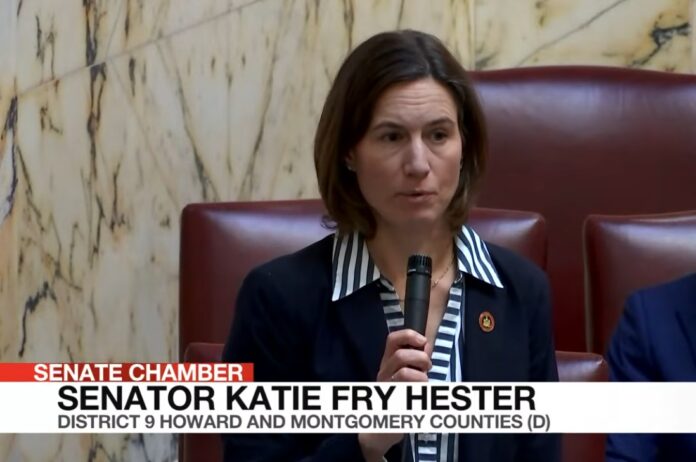
Katie Fry Hester is juggling a myriad of responsibilities. As many Maryland legislators near the midpoint of their 90-day session, she stands out with an exceptionally demanding schedule.
The state senator, currently serving her second four-year term for western Howard County, is the lead sponsor of 20 bills addressing some of the most pressing technology-related issues in Annapolis. These topics include electricity rates and supply, the impact of artificial intelligence, the energy consumption of data centers, and cybersecurity threats to our privacy and finances.
With a background as an environmental engineer and experience as an international consultant, Hester is well-equipped to navigate complex legislative matters.
Recently, Hester has taken on an additional role as chair of the Senate Rules Committee, which is primarily administrative and focused on whether late-filed bills will receive hearings and votes. A congressional redistricting bill aimed at reducing Maryland’s only Republican congressional seat was sent to this committee. However, the Rules Committee convenes only at the discretion of Senate President Bill Ferguson, who strongly opposes mid-term redistricting. Most Senate Democrats share his viewpoint, according to Hester.
In addition, she chairs the energy subcommittee of the Committee on Education, Energy, and the Environment. Moreover, she is the Senate chair of the Joint Committee on Cybersecurity, Information Technology, and Biotechnology, the Joint Committee on Fair Practices and State Personnel Oversight, and she sits on joint committees that focus on audits and legislative ethics, dealing with complaints against lawmakers.
As the saying goes: if you need something done, ask a busy woman.
Hester is efficient and results-oriented. Last session, she was the principal sponsor of 25 bills, principally focused on the issues mentioned earlier. Half of her bills successfully passed the Senate, while 11 made it through the House and were subsequently sent to Gov. Wes Moore. He signed five into law but vetoed five due to budgetary concerns and staffing limitations. However, the Democratic majorities in both houses ultimately overrode these vetoes.
Addressing High Electric Bills
High utility costs are a widespread concern among Maryland residents, placing considerable pressure on lawmakers to find solutions. So, what can they realistically do?
“Not as much as I would like,” Hester remarked during an interview. “Energy management is complex, with regulations coming from several levels.” At the federal level, as well as through PJM—the organization managing the power transmission grid across 13 states—utilities like BGE are overseen by various laws and commissions. Hester participated in several PJM meetings this year, where it was indicated that 75% of the increase in electricity demand can be attributed to new data centers that require vast amounts of energy.
“Costs are soaring due to a national energy shortage, and developing new capacity is a lengthy process,” Hester explained.
“Effectively addressing these challenges at the state level is incredibly difficult. That’s why we urged PJM to ensure that if data centers are permitted to connect, they should bear their fair share of the grid’s load and assume the associated risks, particularly if rolling blackouts become necessary. Let’s prioritize shutting down data centers first,” Hester stated, mentioning that PJM had shown interest in this approach as of January.
One of Hester’s bills, SB2, aims to address high electric costs by banning the use of ratepayer funds for multi-million dollar bonuses awarded to utility executives. While this may only marginally reduce monthly bills, the House version has already advanced.
The Impact of Artificial Intelligence
The rising demand for data centers is largely fueled by the rapid expansion of artificial intelligence, a technology that requires substantial energy. As with any new innovation carrying uncertain consequences, government responses can often lag behind.
One of Hester’s legislative proposals establishes both civil and criminal penalties for the misuse of AI to disseminate misinformation or disinformation regarding elections, including the creation of deepfakes. This bill received unanimous support in the Senate. Another proposal criminalizes the application of similar AI techniques for identity fraud.
Additionally, Hester is considering other bills that explore the economic potential of AI and its role in education. One such initiative is the AI Ready Schools Act, which aims to effectively educate students.
“Employers today are on the lookout for new hires who are not only proficient in AI but can also think critically,” Hester noted.
States like Maryland are taking their own initiatives to regulate artificial intelligence, especially given the federal government’s lack of progress in this area. “Despite the ongoing need for a federal data privacy law, Congress has made no strides on AI regulations,” Hester observed. Furthermore, she pointed out that the previous administration has sought to prevent states from enacting their own AI laws.
She also participates in a bipartisan task force consisting of state legislators focused on AI and cybersecurity. “We have equal representation of Republicans and Democrats, and there is consensus on the necessity of state rights and the regulation of AI. We are all eager for the federal government to take action,” Hester expressed.
Future Elections
Alongside her numerous responsibilities, Hester is also in the midst of her reelection campaign. As of March 1, 2026, she faces no opponents in the Democratic primary, but unlike her two Democratic colleagues from Howard County who have smooth paths to re-election, she does have a Republican challenger.
Just a decade ago, legislative District 9 was under the representation of four incumbent Republicans—a senator and three delegates. In a surprising turn of events in 2018, Hester narrowly defeated Republican Senator and long-serving Delegate Gail Bates by 1,000 votes, while former County Council member Courtney Watson defeated longtime Republican Delegate Bob Flanagan in a different sub-district. Four years later, after the legislature altered the district to remove a strongly Republican area and include parts of Montgomery County, Hester increased her margin of victory to 9,000 votes, with all elected delegates being Democrats. She received considerable financial support from the Senate Democratic campaign.
“When I first ran, 40% of the district were Republicans, a notable factor in my win. Interestingly, many of those individuals later transitioned to independent voters. Presently, the demographics show approximately 40% independent constituents, 40% Democratic, and 20% Republican,” Hester highlighted.
“My motivation to run was rooted in my concern over Trump in 2016. I aimed to safeguard the state and ensure we maintained a robust standing in light of potential federal government instability. I had no idea how tumultuous things would continue to become in 2025 and 2026. My fellow Democrats and I are united in our apprehension regarding federal overreach and its profound impact on Maryland. There are lawless actions emanating from the administration, leading us down a path of dictatorship and fascism.”
The article entitled A busy Senator, Katie Fry Hester, tackles energy, artificial intelligence, cybersecurity, and more originally appeared on MarylandReporter.com.