
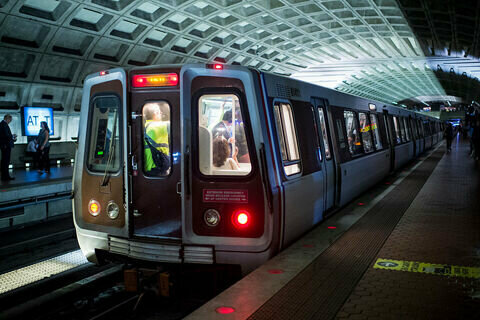
Metro’s Board of Directors has unanimously approved a budget aimed at fully automating the Red Line, the system’s oldest line, with a total cost of nearly $1 billion.
The Red Line, which began operations in March 1976 with only five stops in central Washington, D.C., has since expanded to encompass 32 miles and 27 stations.
According to Metro documents, the aging infrastructure of the Red Line poses significant challenges related to safety, reliability, capacity, and efficiency. These documents highlight that issues such as trespassing incidents and human error are challenging to address with the existing system design.
The budget allocates $913 million for improvements to the Red Line, a move Metro asserts will position the service “on the path to providing world-class transit.”
Additionally, the plan includes efforts to secure federal grants to further support this ambitious project. These elements are part of the proposed fiscal 2027-32 Capital Improvement Plan, which received unanimous approval from Metro’s Board of Directors during their session on Thursday morning.
Debate Over Automation
Among the proposed enhancements is the complete automation of the Red Line, which currently employs significant automation through Automatic Train Operation (ATO). This technology manages the trains’ acceleration, deceleration, and speed via specialized track equipment.
However, Metro employees expressed their reservations during Thursday’s meeting, asserting that ATO does not always work flawlessly and that the system may not be prepared for increased automation.
Christopher Terry, a former Metrobus driver and experienced rail yard worker, informed the board that ATO “consistently glitches, and we are present to address the gaps. Operators serve as the first line of defense in troubleshooting railroad issues.”
While the design of Metro trains allows for substantial automation, the use of automated trains was halted in the wake of a 2009 crash on the Red Line, which tragically resulted in nine fatalities and injured 80 individuals.
Metro reintroduced the ATO system across its network last year for the first time since that incident.
“The trains have always had the capability to operate in ATO mode, and the primary reason we ceased this practice is that the system was not prepared,” stated Jackie Jeter, a train operator and former union president of ATU Local 689.
Further upgrades to the Red Line will also includethe installation of platform doors that will open only when trains arrive at the stations. Such platform doors are already utilized in transit systems in various other countries and have similarities to those employed at Dulles International Airport’s AeroTrain.
Metro officials highlighted that these doors would enhance station safety while facilitating quicker train arrivals and departures. They emphasized that this move toward automation marks the beginning of a broader modernization effort across the system.
“This year, we have witnessed 10 individuals being struck by trains, seven of whom have not survived, and six of these incidents occurred on the Red Line,” remarked Metro General Manager and CEO Randy Clarke. He added that the initiative would provide “an engineering and technology solution” to address such incidents, underscoring the importance of the proposed program.
Future automation efforts may also extend to removing the need for train operators, who currently perform critical functions such as managing doors, making announcements, and monitoring track conditions. This prospect has raised concerns from the union representing rail operators.
“Before considering the removal of operators from trains, we must ensure that every passenger’s safety is guaranteed. As it stands, no one in this room can make that promise,” stated Jampsea Campbell, a Metro station manager and union member, while addressing the board.
Benjamin Lynn from Amalgamated Transit Union Local 689 shared with WTOP, “The union is not against progress. However, we believe that progress can take many different forms.”
ATU Local 689 represents about 8,500 WMATA employees.
Lynn expressed that the union considers this step premature and emphasized that WMATA should first prioritize ensuring that the system is in good repair, noting that approximately $15 billion in repairs have already been identified as necessary.
“Job loss is a significant concern for the union,” Lynn added. “We are also deeply worried about the implications of full automation without human operators for public safety.”
During the meeting on Thursday, Clarke addressed the issue of job security, stating, “Our employees are integral to Metro’s operations. We are just beginning this process. The modernization of the Red Line is not intended to eliminate jobs.”
Plans will be developed to identify future roles for operators within the framework of the modernization project.
“Globally, transit systems approach this in various ways, whether by employing train attendants, operators, or security personnel,” Clarke explained.
Lynn assured that the union would be involved in discussions regarding the consequences of full automation.
Get breaking news and daily headlines delivered to your email inbox by signing up here.
© 2026 WTOP. All Rights Reserved. This website is not intended for users located within the European Economic Area.