Update – Officials in Washington, D.C. have been gaining more clarity regarding the federal assistance available as teams diligently work to fix the collapsed Potomac Interceptor. See original article Potomac River Sewage Spill.
According to district officials, ongoing efforts to repair the collapsed Potomac Interceptor, which has released millions of gallons of sewage into the river since its rupture in January, are becoming clearer in terms of federal aid prospects.
During a repair update from D.C. Water, Clint Osborn, the Director of the D.C. Homeland Security and Emergency Management Agency, highlighted that the existing federal emergency declaration does not authorize the District or D.C. Water to recover funds already utilized for repair efforts.
Osborn clarified that initial assumptions suggesting the federal government would fund 75% of total repairs and clean-up costs were erroneous. He explained that this percentage applies only when federal agencies are assigned tasks through the emergency declaration, and does not extend to the repair work being conducted by D.C. Water.
“We’re continuing to engage in the preliminary damage assessment process with FEMA this week, aiming to persuade FEMA and the White House to elevate our status to a major disaster declaration that would enable reimbursement,” Osborn stated.
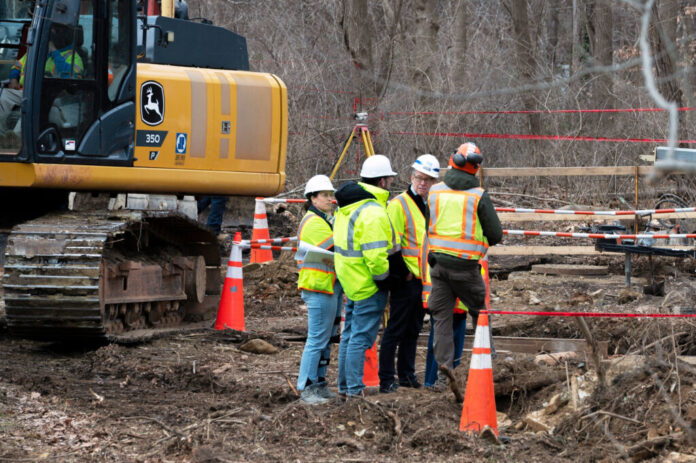
At the repair site, D.C. Water spokesperson Sherri Lewis reported that crews have broadened the excavation site to tackle a considerable rock and debris blockage within the pipe.
According to Lewis, crews have successfully removed a significant portion of this obstruction.
“In the past couple of days, we have detached various sections of the pipe, managing to eliminate around 45 feet of that rock and debris barrier. We are now left with perhaps the last eight to ten feet,” Lewis explained.
Once the remaining debris is cleared, teams will proceed to clean the interior of the pipe, install steel reinforcements, and apply geopolymer material to reconstruct the inner surface. Lewis mentioned that the geopolymer is applied in layers, with each layer requiring adequate time to cure before achieving the desired thickness.
Lewis reaffirmed that D.C. Water remains on schedule to complete the emergency repairs by mid-March. Additionally, she noted that there have been no sewage overflows into the Potomac River since February 8 and that D.C. Water has implemented a 14th pump to enhance the bypass system.
Osborn mentioned that the Environmental Protection Agency (EPA) will assist the District in progressing from weekly to daily water quality testing by providing laboratory resources.
Lewis emphasized that downstream water quality readings should be interpreted considering normal fluctuations observed in the river, as any spikes in water quality might simply reflect the river’s typical behavior rather than being linked to the interceptor’s collapse.
“It’s essential to remain aware of the standard urban river environment before forming any conclusions,” Lewis noted.
She also pointed out that federal representatives, including the EPA Administrator and the Secretary of the Interior, have visited the site.
Residents are advised to steer clear of the construction area, with Lewis noting that some individuals have been approaching the work zone from Clara Barton Parkway.
D.C. Water has also recently uncovered a 2024 condition assessment for the pipe segment and is currently reviewing it alongside earlier reports.
“We are dedicated to a thorough review of this information and will share our findings in full once the evaluation is complete,” Lewis stated.