
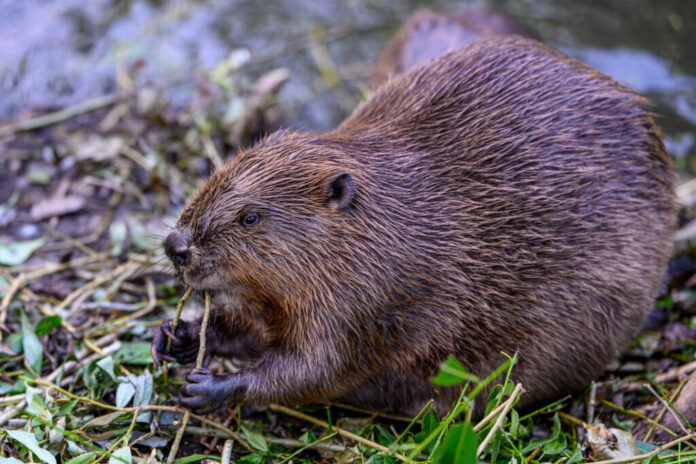
According to Joshua Tabora from the Maryland Department of Natural Resources, beavers are not inclined to seek conflict unless there is a significant issue present.
Typically considered non-aggressive, the recent spate of three beaver attacks within a month at two state parks in Maryland has raised numerous questions and sparked widespread concern among the public.
Joshua Tabora, a furbearer biologist with the Maryland Department of Natural Resources, emphasized to WTOP, “This is not an animal that’s going to seek out conflict unless something is really wrong.”
In fact, both beavers involved in the incidents at Cunningham Falls State Park tested positive for rabies. The beaver linked to the third incident at Seneca Creek State Park was not recovered, but it is presumed to be rabid.
Although the remains of another beaver were discovered in Seneca Creek State Park, Tabora mentioned that those remains were in an unsuitable condition for rabies testing.
Beavers contracting rabies is relatively rare.
“Our consistent rabies positives are primarily found in raccoons, skunks, foxes, domestic cats, and bats, followed by cows and horses, which show higher rabies incidence than beavers,” stated Dr. Jen Riley, managing director at Blue Ridge Wildlife Center located in Boyce, Virginia, in an email to WTOP.
This leads to the question of how at least three beavers managed to contract the virus. Tabora indicated that ongoing testing has provided insights into this situation.
“There are specific rabies strains associated with different species,” he explained, referring to the first beaver attack by stating, “In this instance, that animal tested positive for raccoon-type rabies.”
Tabora further clarified, “We have no indication — and I’ve reiterated this multiple times — that there’s a heightened rabies prevalence in either Frederick or Montgomery County. It doesn’t seem that the raccoon population has surged compared to previous years.”
Despite the logical conclusion that increased encounters between beavers and raccoons might be occurring, it’s still uncertain what is triggering these events.
“It may be premature to attribute it to any specific factor,” Tabora remarked.
As an expert in studying and monitoring various mammals across Maryland, Tabora reassured the public that there is no need for alarm upon encountering beavers in their natural habitat. He noted that despite beavers being crepuscular — most active during dawn and dusk — seeing one during the day does not automatically indicate rabies.
“In Maryland, there are no wildlife species that should elicit concern just by their presence at any time of day. For instance, just because you see a raccoon active at noon does not mean it is necessarily rabid,” Tabora stated.
When encountering wildlife, he advised maintaining a safe distance of at least 25 yards. Beavers can weigh anywhere from 25 to 70 pounds, with the heavier individuals being considered exceptionally large.
Tabora explained that a beaver’s natural instinct upon seeing a human is often to dive into the water for safety. However, he noted, “They can be territorial, so if a human gets unusually close to a beaver or its den, biting is a possibility.”
While observing a raccoon, fox, or beaver during daylight does not imply that it is rabid, Tabora cautioned that there are specific behavioral signs to watch for.
“If you encounter an animal out during the day that is walking in circles, foaming at the mouth, appears disoriented, or does not exhibit fear of humans, you should reach out to authorities,” Tabora advised.
If you suspect a rabid animal in any of the parks, Tabora recommended contacting the DNR Wildlife Hotline at 410-260-8540. This hotline is critical for reporting sick or injured wildlife.
In circumstances where there may have been exposure to rabies, officials from the Maryland Department of Health advise contacting local animal control, the health department, or law enforcement authorities.
Stay updated with breaking news and daily headlines by signing up for our email newsletter here.
© 2026 WTOP. All Rights Reserved. This website is not intended for users located within the European Economic Area.