
Montgomery County Planning Board Endorses Strategy and Boundary for Wheaton Master Plan
WHEATON, Md. – In a recent meeting held on May 7, the Montgomery County Planning Board, a component of The Maryland-National Capital Park and Planning Commission (M-NCPPC), approved both the Scope of Work and the designated boundary for The Wheaton Plan: A Georgia Avenue Community Plan. This Scope of Work outlines the Montgomery County Planning Department’s methodology for establishing a new long-term vision along with actionable recommendations for downtown Wheaton.
The Montgomery Planning team is actively engaging with local residents, business owners, and other stakeholders to assess current conditions, market dynamics, and recent investments. This collaborative effort will lead to a vision and set of recommendations that resonate with Montgomery County’s priorities. The plan will comprehensively cover aspects such as land use, zoning, urban design, housing, economic conditions, transportation, environmental concerns, parks and open spaces, historic preservation, and community facilities, while seamlessly integrating relevant countywide initiatives.
“The Wheaton Plan presents an opportunity to harness Wheaton’s strengths while directly tackling the challenges faced by the community,” commented Carrie Sanders, Chief of the East County Planning Division. “Through this initiative, we will collaborate closely with the community to establish a practical, actionable vision that supports small businesses, enhances transportation safety and connectivity, expands housing availability near transit routes, and utilizes recent public investments to foster a more vibrant Wheaton.”
For those interested, the Scope of Work presented at the May 7 meeting offers detailed insights. During the meeting, the Planning Board also made amendments to the plan’s boundary.
The Wheaton Plan: A Georgia Avenue Community Plan builds upon the momentum of several recent initiatives, which include the 2012 Wheaton Central Business District and Vicinity Sector Plan, the 2023 Wheaton Downtown Study, the 2023 Streetscape Standards, and the Wheaton Downtown Study. The plan responds to community calls for improved walkability, enhanced transportation safety, and greater connectivity.
Residents are encouraged to stay informed about the plan by visiting the plan’s website and signing up for an e-letter or text updates. Additionally, the plan has launched the #WeAreWheaton community engagement campaign to gather insights on how residents experience their day-to-day life in Wheaton, while also addressing challenges and opportunities they foresee for the future. For those who work, shop, or reside in Wheaton, sharing your story is a chance to contribute to this important dialogue.
Plan Boundary Overview
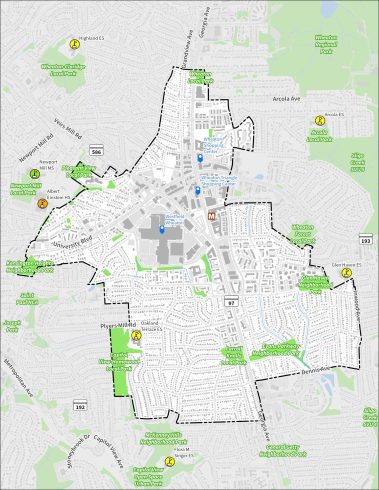
The approved master plan boundary covers approximately 1,000 acres and is centered on downtown Wheaton. This area is structured around the intersection of Georgia Avenue, University Boulevard West, and Veirs Mill Road, forming the heart of the Wheaton Triangle. Additionally, it includes residential neighborhoods along Georgia Avenue within a one-mile radius from the Wheaton Metro Station, as well as select properties along University Boulevard westward of Veirs Mill Road.
Notable properties within the plan boundary consist of Westfield Wheaton Mall, the Wheaton M-NCPPC Headquarters, the Wheaton Recreation Center and Library, the Wheaton Metro Station and bus loop (Wheaton Station), Marian Fryer Town Plaza, eight nearby parks, and Oakland Terrace Elementary School.
Key Elements of the Plan Framework
Land Use, Zoning, and Urban Design
Building upon insights from the Wheaton Downtown Study, the plan will target transformative development on key larger sites while accommodating mid- and small-scale mixed-use infill projects to reinforce the downtown core and support existing small businesses. Strategic initiatives will consider enhanced street connectivity near the Wheaton Station, adjustments to the bus loop configuration for the station, and possibilities for repurposing existing commercial facilities. Furthermore, it will explore the establishment of new zoning categories to facilitate additional housing types along Wheaton corridors and close to Metro stations, alongside limited commercial uses to provide essential neighborhood services.
Housing
The Wheaton Plan aims to increase the availability of both market-rate and affordable housing, setting an ambitious housing-production target of 3,200 to 3,700 new units by 2050 within the designated area. The ambition is to introduce diverse housing types and sizes while also safeguarding existing market-rate affordable housing. With more than half of renters in Wheaton facing cost burdens, the plan will tackle affordability issues while concurrently addressing the need for reinvestment in aging structures and enhancing the connections between Wheaton’s neighborhoods and its core. Additionally, it will assess potential opportunities for housing development on publicly owned properties situated near Metro stations and county parking lots, leveraging redevelopment guidance from previous plans.
Transportation
To foster a more walkable downtown Wheaton and align infrastructure with sustainability objectives, the plan will review existing transportation networks. Key considerations will include equity, transportation safety, and accessibility, especially for vulnerable populations, ensuring high-quality mobility options are available and supporting Vision Zero initiatives aimed at eliminating serious injuries and fatalities. The plan will also evaluate accessibility in Wheaton to enhance neighborhood linkages and will address multimodal requirements—including transit, walking, bicycling, street design, parking, public spaces, and evolving mobility trends—while working closely with forthcoming Bus Rapid Transit projects on Veirs Mill Road, University Boulevard, and Georgia Avenue, thereby optimizing connections to the Wheaton Station bus loop and Westfield Wheaton Mall.
Parks and Open Spaces
The plan will evaluate how well existing and proposed parks, trails, and open spaces contribute to an engaging downtown Wheaton. The planning process entails reviewing previous recommendations, assessing current park conditions and service levels, and collaborating with community members to pinpoint future requirements for recreational spaces, gathering areas, and improved access. The ultimate goal is to reimagine downtown Wheaton and neighboring communities as a welcoming center for health, wellness, and cultural identity.
Environmental Resilience
The plan seeks to implement strategies to reduce greenhouse gas emissions, mitigate the urban heat island effect, manage stormwater issues, and reinforce climate resilience through initiatives like expanding tree canopies, embracing nature-based solutions, and integrating innovative renewable energy opportunities. Recommendations are aimed at harmonizing urban design with the county’s environmental resilience objectives, fostering an urban environment in Wheaton that artfully incorporates green resilience features, enhancing its appeal as a cooler, greener, and more inviting location for living, working, and enjoying leisure time—consistent with its designation as an Arts & Entertainment District.