
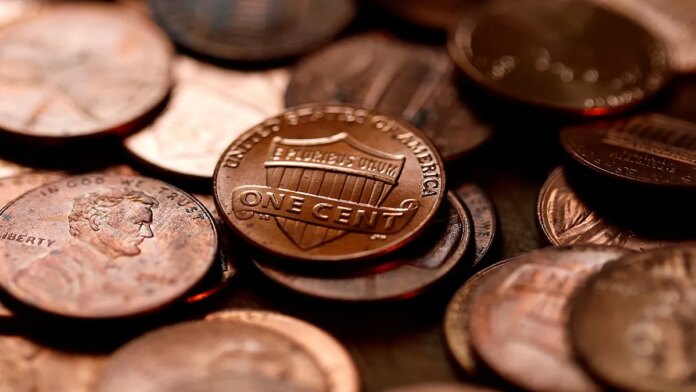
As the presence of pennies diminishes across the United States, numerous businesses are seeking federal guidance on how to manage cash transactions in an increasingly cashless environment.
Should retailers opt to round transactions up or down? Is it more beneficial to round in favor of the customer or the business itself?
” data-medium-file=”https://i0.wp.com/southernmarylandchronicle.com/wp-content/uploads/2025/12/pennies.jpg?fit=1200%2C675&quality=89&ssl=1″ data-large-file=”https://i0.wp.com/southernmarylandchronicle.com/wp-content/uploads/2025/12/pennies.jpg?fit=1200%2C675&quality=89&ssl=1″ src=”https://i0.wp.com/southernmarylandchronicle.com/wp-content/uploads/2025/12/pennies.jpg?resize=780%2C439&quality=89&ssl=1″ alt=”” class=”wp-image-327057″ />
Thus far, federal bodies have not responded to calls for guidance. Although some businesses are establishing their own cash handling policies, states are starting to take action amid rising confusion.
Despite the seemingly minor amounts involved in rounding (only a few cents per transaction), this issue raises significant questions about consumer protection and legal implications. Retailers must navigate the risks of potential lawsuits while policymakers are concerned about safeguarding vulnerable consumers who depend on cash for daily transactions.
In February, President Donald Trump initiated efforts to phase out the penny, citing the high cost of production, which stands at about 3.7 cents per coin. Even before its final minting last month, businesses and banks across the country were already reporting penny shortages.
To provide clarity, lawmakers in New York have proposed a bill similar to Canada’s rounding approach — adjusting cash transactions to the nearest five cents. Additionally, authorities in Georgia and Utah have issued guidance, although it is nonbinding.
“States do not possess the luxury of waiting for federal directives,” asserted Katherine Tschopp, a senior associate at the government relations firm MultiState.
Adding to the complexity is the increasing number of jurisdictions requiring businesses to accept cash. This is a protective measure for consumers who may lack access to credit cards or digital payment methods.
In November, New York became the ninth state to adopt such a regulation, as reported by MultiState. Numerous major cities are also enforcing cash acceptance policies.
A bipartisan group in the federal legislature has proposed legislation in the U.S. House and Senate to mandate that all cash transactions be rounded to the nearest five cents; however, neither proposal has yet been scheduled for a vote.
The ongoing federal government shutdown and contentious discussions regarding health insurance subsidies have stalled talks about the penny issue. Tschopp anticipates that the federal government will eventually establish a national policy for rounding. Meanwhile, she expects additional states to step forward with their own regulations.
New York Democratic Assemblymember John T. McDonald III has expressed his support for Trump’s decision to phase out the penny but stresses the need for immediate guidance for businesses.
“In the absence of federal action, it is crucial for states to take the initiative and provide clarity — a sense of clarity for all parties involved: consumers, merchants, and the state,” McDonald conveyed to Stateline.
Currently, no legislation regarding penny rounding has been introduced for Maryland’s 2026 General Assembly session.
Methods of Rounding
McDonald’s proposed bill mirrors Canada’s rounding policies following the elimination of its one-cent coin in 2012. His bill advocates for symmetrical rounding of after-tax cash transactions to the nearest five cents. Transactions that end with one or two cents, as well as six or seven cents, would round down. Conversely, those ending in three or four cents, along with eight or nine cents, would be rounded up.
For example, a consumer making a purchase of $1.99 would receive no change, while a retailer would return a nickel for a payment of $1.97.
McDonald is also involved with the National Conference of State Legislatures’ State and Local Taxation Task Force, which has been examining the penny issue. This task force has recommended symmetrical rounding as the most equitable method for both merchants and consumers.
McDonald noted that the NCSL group arrived at a bipartisan agreement on this matter and that he has not encountered any opposition from businesses or consumer groups in New York regarding his proposed legislation.
“In today’s political climate, where discussions often become contentious, it would be refreshing to find common ground on an issue such as this. Starting with the humble penny would be a fitting beginning,” he stated.
– New York Democratic Assemblymember John T. McDonald III
Recently, South Dakota Republican state Sen. Tim Reed encouraged state lawmakers to initiate discussions with agencies, retailers, and the general public regarding this issue.
As a co-chair of the NCSL task force, Reed emphasized the need for guidance for businesses and reassurance for consumers. While he recognized the concerns regarding “strategic pricing”—where retailers may intentionally set prices to benefit from rounding—the group’s findings categorized this risk as “limited.
“People worry about being overcharged or undercharged,” Reed remarked during an NCSL virtual event on the penny issue. “It’s essential for everyone to understand that the system will ultimately balance out.”
New York Democratic state Sen. James Sanders Jr. stated that the cash acceptance law he sponsored earlier this year ensures that individuals without access to smartphones or banking services are not marginalized from commerce. This law mandates that cash-paying customers cannot be charged higher fees than other buyers.
“Otherwise, we would be creating a two-tiered system,” he said, emphasizing that cash serves as “a critical resource” for working families, seniors, immigrants, and small businesses.
Sanders advocates for retailers to round down to the nearest nickel for cash transactions to provide consumer protection.
“For large corporations, this could translate to significant financial impacts, amounting to hundreds of thousands of dollars if they consistently round up. Though each rounding transaction affects only a few cents, when compounded across thousands of daily transactions, it effectively raises the cost of products without any accountability,” he detailed.
Sanders indicated that he plans to introduce legislation on this topic soon, while remaining open to McDonald’s symmetrical rounding proposal. Above all, he stressed that businesses are seeking definitive guidance.
“Our aim is not to undermine businesses but to prevent consumers from being disadvantaged,” he expressed. “Those I’ve been in contact with are genuine and wish to ascertain the best course of action in a cash-strapped society.”
A Swift Transformation
The U.S. Mint in Philadelphia minted the final penny on November 12, but penny shortages were already prevalent at that time.
By mid-November, over 100 of the government’s 165 coin distribution locations nationwide were out of pennies, according to the Retail Industry Leaders Association, which represents major retail chains like CVS, Target, and 7-Eleven.
A survey conducted by the association in November revealed that six national chains had more than 1,000 stores without any pennies available.
The association noted that most of the respondents were rounding cash transactions in favor of customers — consistently rounding down to the nearest five cents. While this practice benefits consumers, it reportedly “costs businesses millions of dollars as small amounts accumulate across tens of thousands of cash transactions daily.”
As states contemplate this issue, the association is advocating for a federal resolution.
“We strongly urge the federal government to promptly address this issue, enabling uniform adjustments for retailers operating across multiple states,” noted Austen Jensen, the organization’s senior executive vice president of public affairs, in a statement to Stateline.
Other organizations, including the American Bankers Association, have similarly called for federal intervention.
“They are certainly concerned and are requesting a federal solution,” explained Christopher Phillips, a partner at Holland & Knight law firm. “The abrupt decision to stop minting pennies has led to a swift nationwide shortage.”
For retailers, the situation poses both practical and legal challenges, according to Phillips, who works with payment system companies and fintech firms.
In many jurisdictions mandating cash acceptance, laws explicitly prohibit charging cash customers more, with penalties applied for violations, amplifying the risk of hefty fines. Furthermore, merchants could face potential class-action lawsuits over rounding policies, particularly if consumers claim they are charged more than advertised or experience unfair business tactics.
“The unanticipated consequences of these administrative rules, in conjunction with existing laws, create tangible issues that were never anticipated,” Phillips noted.
At present, merchants are formulating their own cash handling policies.
Owing to the penny shortage, the East Coast convenience store chain Sheetz has encouraged customers to switch to cashless options or round up their payments for charitable contributions. They have even offered free beverages to those who redeem 100 pennies.
Kwik Trip, a convenience store chain in the Midwest, announced in October that their cash registers would automatically round down cash transactions to the nearest nickel, favoring customers.
However, Phillips pointed out that without a federal standard, practices across different locations are inconsistent. Rounding can lead to winners and losers with each transaction. Some companies want to standardize their approach nationwide, while others are only willing to round down if compliance is mandated.
“Others feel that this is actual revenue for them,” he remarked. “They are not prepared to forfeit it merely for convenience.”
Stateline reporter Kevin Hardy can be reached at khardy@stateline.org.
This article was initially produced by Stateline, part of States Newsroom, a nonprofit news organization supported by grants and a coalition of donors as a 501(c)(3) public charity.