
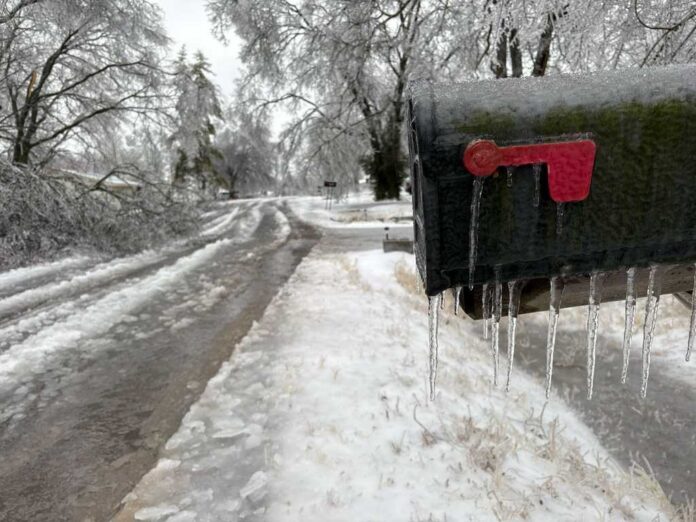
A significant winter storm unleashed a mix of sleet, freezing rain, and snow across large portions of the United States on Sunday, plunging temperatures into subzero levels and severely disrupting both air and road travel. The sheer weight of ice caused numerous tree branches and power lines to snap, leaving approximately a million homes and businesses in the Southeast without electricity. The National Weather Service warned that ice and snowfall would persist into Monday in several regions, followed by an onset of extremely low temperatures, which could prolong “dangerous travel and infrastructure challenges” for many days. Heavy snowfall is expected from the Ohio Valley extending to the Northeast, whereas “catastrophic ice accumulation” is forecasted for areas stretching from the Lower Mississippi Valley to the Mid-Atlantic and Southeastern states. “This storm is remarkable because of its extensive reach,” noted weather service meteorologist Allison Santorelli in a phone interview. “It’s impacting areas from New Mexico to Texas and stretching all the way to New England, covering a distance of about 2,000 miles.” By Saturday, President Donald Trump had sanctioned emergency declarations for at least a dozen states, and the Federal Emergency Management Agency (FEMA) had pre-positioned supplies, personnel, and search and rescue teams in various locations, according to Homeland Security Secretary Kristi Noem. New York Governor Kathy Hochul informed the public that the state was preparing for an extended period of cold weather and some of the highest snowfall totals seen in recent years. Regions close to the Canadian border have already recorded alarming subzero temperatures, including Watertown at minus 34 degrees Fahrenheit and Copenhagen at an astonishing minus 49 degrees Fahrenheit. “An Arctic siege has engulfed our state,” Hochul stated. “It is brutal, bone-chilling, and poses a danger to everyone.”
Effects of the Storm
In Corinth, Mississippi, widespread power outages prompted Caterpillar to advise its employees at the remanufacturing facility to remain at home on Monday and Tuesday. “May God have mercy on Corinth, MS! … The sound of snapping trees and their crashing falls throughout the night have been disturbing, to say the least,” lamented resident Kathy Ragan on Facebook.
Video below: Dashcam captures moment a tree falls due to the weight of ice in North Louisiana.
In Nashville’s eastern district, resident Jami Joe, age 41, still had power on Sunday afternoon, but she worried that it wouldn’t last long as heavily weighed branches from mature oak and pecan trees continued to fall around her home. “It’s just a matter of time before a branch hits a power line,” she forewarned.
Meanwhile, in Little Rock, Arkansas, local authorities indicated that accumulated snow and sleet likely caused an awning to collapse onto several houseboats, resulting in six people being rescued and 22 others evacuated, according to Pulaski County officials.
Storm Disrupts Power and Travel
As reports came in on Sunday morning, around 213 million individuals found themselves under some form of winter weather advisory, according to Santorelli. Approximately 1 million customers were without power, per data from poweroutage.us.
Tennessee faced the most significant issues with about 337,000 customers without power by midday Sunday, while Louisiana and Mississippi were also affected, each reporting over 100,000 outages. Additionally, numerous residents in Kentucky, Georgia, Alabama, and West Virginia faced the same fate.
Flight disruptions were severe, with around 11,000 flights canceled and more than 14,000 delayed on Sunday, as outlined by flight tracking service flightaware.com. The airports in Philadelphia, Washington D.C., Baltimore, North Carolina, New York, and New Jersey were heavily impacted.
At Philadelphia International Airport, screens displayed numerous canceled flights, and few vehicles were seen arriving on Sunday morning, while almost all flights were canceled at Reagan National in Washington.
Extreme Cold Complicates Matters
Even after the ice and snow cease, the perilous conditions will persist, cautioned Santorelli. “After the storm passes, a significant drop in temperature will take hold over most of the eastern two-thirds of the country, east of the Rockies,” she explained. This frigid weather will delay the melting of ice and snow, potentially stalling efforts to restore power and other essential services.
Video below: Experience the sound of ice-laden trees cracking in Mississippi.
On the Gulf Coast, temperatures were relatively mild on Sunday, ranging from the high 60s to low 70s, but forecasters anticipated a dip into the high 20s to low 30s by Monday morning. The National Weather Service issued warnings regarding damaging winds and a slight threat of severe storms, including the possibility of tornadoes.
In New York City, Mayor Zohran Mamdani reported that at least five individuals, who were discovered outside as temperatures dropped on Saturday before substantial snowfall began, had died, though the exact causes of death are still under investigation. The mayor urged residents to remain indoors and refrain from travel: “Our priority is to ensure that every New Yorker makes it through this storm safely.”
In Louisiana, two men succumbed to hypothermia related to the storm, as reported by the state’s health department. Across the affected areas, officials declared that schools would be closed or transitioned to remote learning on Monday.
Recovery May Extend Over Time
In Oxford, Mississippi, local authorities advised residents via social media on Sunday morning to remain indoors due to the hazardous conditions outside. Utility crews were also withdrawn from their assignments during the night.
“Owing to life-threatening conditions, Oxford Utilities has made the challenging decision to withdraw our crews from the roads for the night,” the utility company shared on Facebook early Sunday. “Trees are actively falling and snapping around our linemen while in the bucket trucks.”
Tippah Electric Power in Mississippi indicated that the damage was “catastrophic,” and restoration efforts could take “weeks rather than days.”
The Tennessee Valley Authority, which supplies power to various utilities in the region, stated that while the main power system remained stable, overnight icing had led to power outages in northern Mississippi, northern Alabama, southern middle Tennessee, and the Knoxville area.
Dangerous icy roads complicated travel in northern Georgia, prompting the Cherokee County Sheriff’s office to post on Facebook, “It’s a serious situation when Waffle House is closed!” along with a photo of a locked-up restaurant. The operational status of Waffle House locations has become an informal metric for gauging the severity of weather-related crises in the South.