
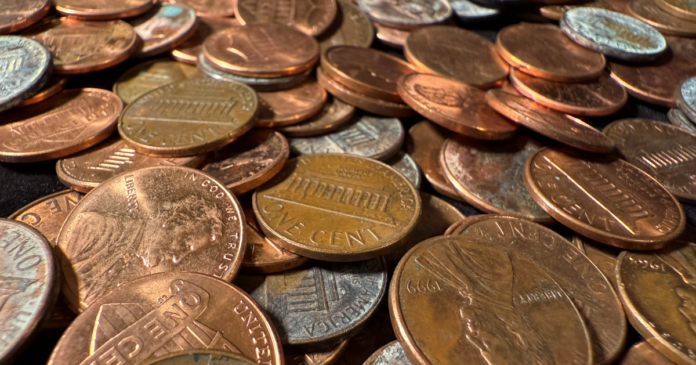
WHITE MARSH, Md. — The production of pennies has been officially discontinued, prompting businesses to rethink how they manage cash transactions. Following the U.S. Treasury’s decision last summer to stop making the 1-cent coin due to soaring costs—nearly 4 cents to produce each penny—banks are experiencing shortages. As a result, retailers are left to deal with checkout challenges without definitive guidance from federal or state authorities.
“We stopped receiving delivery of pennies. The bank assured us we would get them, but a few weeks later, we found ourselves still penny-less,” shared Leslie Richardson, president of Richardson Farms in White Marsh, Md.
In response to the situation, Richardson activated a rounding feature embedded in his cash registers. This system rounds down purchases ending in 1 or 2 cents to the nearest 5 cents, while those ending in 3 or 4 cents round up. The same rounding principle applies to amounts ending in 6-7 cents (rounding down) and 8-9 cents (rounding up).
“Yes, we still accept pennies, as they remain legal tender. However, we seldom have them unless a customer provides them,” Richardson explained.
Jeff Lenard, a spokesperson for the National Association of Convenience Stores, described this predicament as “the great penny mess.”
“The issue is that when people receive change, they tend to stash it away—in jars, ashtrays, you name it—which prevents it from circulating back into the economy. Consequently, the lack of pennies means we need a steady supply of new coins, which isn’t happening right now, resulting in this shortage,” Lenard noted.
This shortage presents difficult decisions for retailers, according to Lenard.
“Should you round in favor of the customer and potentially lose a few cents? Or do you round up or down and risk confusing or frustrating customers who may not understand the system?” he questioned. “For convenience stores, if every establishment rounded in favor of the customer, it could cost our industry approximately a million dollars each day.”
In response to this dilemma, federal lawmakers have proposed the Common Cents Act, which seeks to standardize rounding practices across the nation using the same method employed by Richardson. However, no votes on this legislation have been scheduled as of yet.
This proposed law takes cues from countries like Canada and Australia, which have successfully implemented rounding initiatives for several years.
“Canada managed this through a comprehensive year-long education campaign, followed by a gradual transition. While we’ve approached this differently, there’s still an opportunity for us to adapt,” Lenard stated.
Some consumers have voiced their concerns about these new policies. Phyllis Atkins-Mackey was taken aback when she first noticed a rounding sign at Richardson’s store.
“I was surprised to walk in one day and see a sign indicating that my purchase would be rounded to the nearest nickel without even asking for my input. What if I have my exact change? Do I want to donate the difference to charity?” Atkins-Mackey expressed.
Data from Richardson indicates that the rounding system tends to favor customers over time. His point-of-sale (POS) system meticulously tracks all rounding transactions.
“Our POS system accurately records rounding, and over the past week, customers have received $1.51 more from us than we lost. That loss is still less than the cost of acquiring pennies,” Richardson disclosed.
While the statistics may balance out, Lenard emphasizes that building customer trust remains a significant hurdle.
“When customers are unaware of how the system works, the default reaction is distrust. This situation calls for clear communication to reassure them that we’re doing the best we can,” he said.
Atkins-Mackey believes that improved communication and uniform policies would make it easier for consumers to grasp these adjustments.
“If we take a moment to consider the broader implications and provide guiding policies, it would help ensure consistency across all stores,” she suggested.
The Treasury Department is now encouraging consumers to spend any pennies they have at home and advises retailers to round cash transactions to the nearest 5 cents. Nonetheless, the department maintains that businesses should continue to accept pennies and offer penny change whenever feasible.
Similar to pennies, nickels are also facing production cost issues, with each 5-cent coin costing nearly 14 cents to manufacture. There has been discussion about whether nickels should be discontinued next, but no formal decisions have been made. According to the U.S. Mint’s 2024 Biennial Report to Congress, it costs around 6 cents to produce a dime and 15 cents for a quarter.
This story was initially reported on-air by a journalist and has been adapted here with the help of AI. Our editorial team carefully verifies all reporting across platforms to ensure fairness and accuracy.