On the last day of its legislative session, the Prince George’s County Council approved a comprehensive set of bills, including one that aims to regulate tobacco sales and may potentially lead to a lawsuit against the county this year.
The new legislation imposes restrictions on stand-alone convenience stores that are less than 5,000 square feet and do not sell gasoline or alcohol, prohibiting them from selling tobacco products altogether.
Store owners made their voices heard during the council meeting in Largo, Maryland, as they sought to convince the council members to reconsider the proposed measure.
One business owner expressed concern by stating, “Regulate us fairly, rather than putting our businesses in a position where survival becomes impossible. Give existing legally operated businesses a reasonable opportunity to continue under strict rules.”
Several store owners shared their personal stories about the investments and sacrifices they had made to establish their businesses, arguing that tobacco sales are crucial for their survival.
Some owners also pointed out that customers seeking tobacco products would simply turn to nearby gas stations that are permitted to sell tobacco, or to stores in Washington D.C. and Virginia where no such restrictions are in place. They claimed that this would ultimately deprive Maryland of the tax revenue generated from cigarette sales.
Additionally, there are legal concerns surrounding the new regulation.
Earlier this year, the council passed legislation that allowed it to impose special fees on liquor and tobacco stores, as well as storage facilities. In that instance, County Executive Aisha Braveboy allowed the bill to become law instead of vetoing it, citing the strong majority that supported it.
This led to a lawsuit that is currently still unfolding in the courts.
The council also decided to place a similar piece of legislation on the ballot as a referendum this year, giving the voters an opportunity to express their opinions on the matter.
In a close vote, the tobacco sales restriction passed with a 6-3 margin, while two council members chose to abstain.
A legal analysis conducted by the county’s Office of Law and the Park and Planning Commission revealed doubts about the legality of the bill and predicted that it could provoke a lawsuit.
Lobbyist Bruce Bereano cautioned the council, asserting that the proposed measure is illegal. He stated emphatically, “There’s no doubt whatsoever. I know the county attorney’s office has said this is susceptible to litigation, but in reality, it is illegal.”
Bereano referenced two opinions from Maryland’s highest court concerning previous attempts to limit tobacco sales.
“Your bill is unconstitutional on its face,” he argued. “It’s unconstitutional because the entire subject area, the entire product, has been preempted by the state of Maryland through the legislature in their regulation and licensure and taxation of this product. If this bill were to pass, aside from it being unconstitutional, it would impact state revenues, sales taxes, and tobacco taxes, which are collected and used by the state of Maryland.”
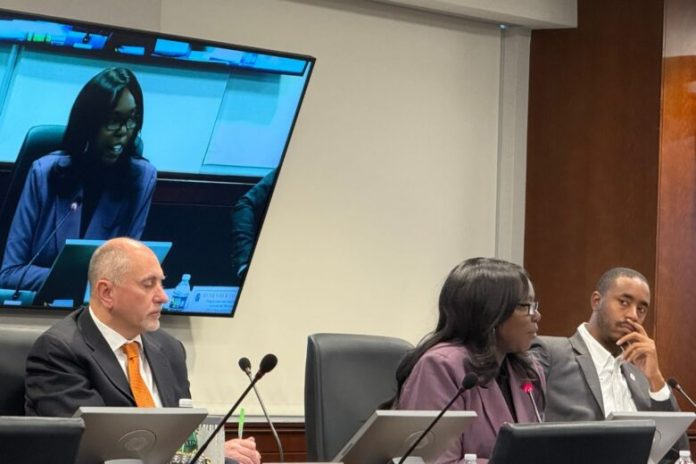
During the public hearing on the bill, Council Chair Krystal Oriadha remained silent. However, following the bill’s passage, she remarked that while tobacco sales may not be as significant an issue in other areas of the county, they are indeed a pressing concern in her district.
“It’s a huge issue that we have to figure out how to address because we deserve better,” she stated. “It’s disheartening if we say that the only way we can have a corner market or a bodega or a store in our community is if we’re supporting it with cigarettes and tobacco and paraphernalia, especially when I visit those stores and see they offer no groceries—just chips, cereal, and tobacco products. That is all.”
The dissenting votes came from council members Jolene Ivey, Sydney Harrison, and Wanika Fisher. They each expressed their concerns regarding the legal implications tied to the legislation.
Fisher, in particular, related to the experiences of her immigrant parents who owned small businesses in the same area as many of those affected store owners.
“I haven’t really heard testimony asking for this bill from the community,” Fisher stated. “As the first South Asian to sit on the county council, and as an African immigrant, I truly empathize with what the business owners are experiencing, and I believe there are significant issues surrounding state law in connection with this.”
Stay updated with breaking news and daily headlines delivered to your email inbox by signing up here.
© 2026 WTOP. All Rights Reserved. This website is not intended for users located within the European Economic Area.