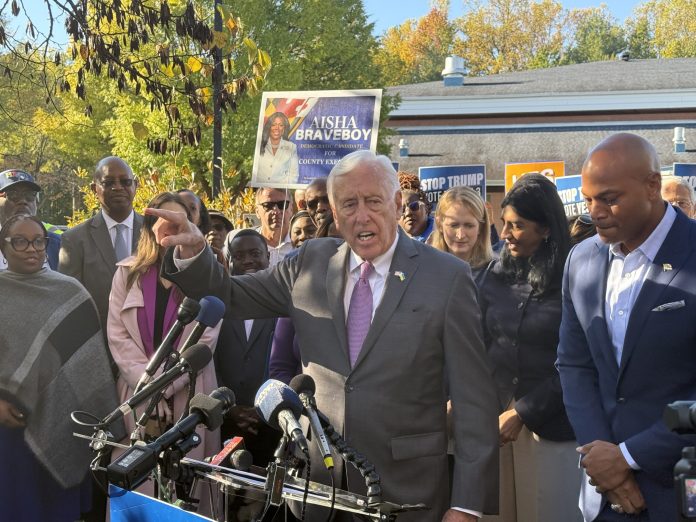
As the countdown to Election Day narrows to eight days, Maryland Democrats from various levels of government convened in Bowie on Monday for a rally aimed at mobilizing support.
However, during the approximately 45 minutes of discourse, the focus primarily shifted away from candidate platforms and typical voter concerns. Instead, the rally was dominated by discussions surrounding President Donald Trump and a significant ballot measure related to redistricting, emphasizing their interconnection.
Maryland Democrats emphasize the importance of this ballot measure ahead of the November midterms
“Donald Trump is attempting to make us believe he isn’t on the ballot,” stated retiring Rep. Steny Hoyer, who serves Maryland’s 5th District. “In Maryland, he is very much present on the ballot. It’s referred to as Question 3. He seeks a ‘no’ vote on Question 3 because he fears it will diminish his control and limit your own influence.”
Governor Wes Moore, who is seeking reelection, also voiced his backing for Question 3, a measure designed to facilitate the Maryland Democratic legislature’s capacity to engage in gerrymandering. Simultaneously, he expressed a desire for broader national redistricting reform aimed at prohibiting practices similar to what is proposed in Maryland, as well as actions taken by states like Texas and Louisiana.
“It will not come to fruition if we let Donald Trump manipulate the rules at this moment, because that’s his intention—he wishes to maintain unchecked power,” Moore emphasized. “Over the past two years, we’ve witnessed the consequences of such unchecked power: soaring inflation at five-year highs, rising national unemployment rates, escalating gas prices, and an increase in energy and grocery costs—all while his personal wealth continues to grow.”
Even in addressing issues directly affecting voters, Lt. Governor Aruna Miller redirected the conversation back to the central theme of the rally.
“Affordability remains the top priority for us, and this will be an ongoing focus,” Miller remarked. “However, Question 3 is also a factor in this conversation, particularly taking into account the impact of Donald Trump’s policies on the state—resulting in the loss of 31,000 federal jobs in Maryland.”
The general sentiment among Maryland voters regarding this issue remains uncertain. Recent polling from the University of Maryland, Baltimore County Institute of Politics indicated that a significant percentage of voters oppose the referendum, with a margin of approximately two to one. Despite this, the referendum has become a pivotal concern for Moore, and while many Democrats share this focus, they have yet to acknowledge its potential significance in the upcoming election.
One participant, however, openly acknowledged the situation’s gravity.
“From my perspective, many of the races are already set in place,” noted state Sen. Ron Watson, one of the few speakers who referenced issues energizing voters this election cycle. “We now need to consider the bigger picture, which primarily revolves around Question 3.”
He referred to the lack of federal assistance in the aftermath of severe flooding in various regions of the state, along with the Trump administration’s efforts to hinder the relocation of the FBI headquarters to Greenbelt, which are also weighing on public sentiment.
“People clearly understand that when we talk about affordability and the rising costs of living, including gasoline, these challenges originate from higher levels of leadership,” Watson stated.
“We must address the root causes effectively, and we believe that’s what Question 3 represents.”
State Delegate Adrian Boafo, a candidate in Maryland’s 5th Congressional District, pointed out that Democrats can prioritize multiple issues simultaneously. He asserted that the passage of the referendum is critical for Maryland, particularly if Trump encourages Republican-led states to further manipulate their congressional maps.
“We anticipate that Donald Trump will return next year, attempting to influence yet more congressional district maps,” Boafo noted. “Our hope is to secure a majority in both the House and the Senate, enabling us to enact bipartisan legislation to cease gerrymandering. However, if those efforts fail, Maryland must respond, and that’s the essence of Question 3.”