
Located just a few blocks from Lexington Market in Baltimore, a six-story data center occupies a building adorned with detailed architecture. This facility consumes enough electricity to light up a city comparable in size to Dundalk, Maryland.
In 2024, the operator of this expansive 150,000-square-foot data center revealed plans to expand its capacity threefold over the coming years to accommodate the surging demands of the artificial intelligence sector.
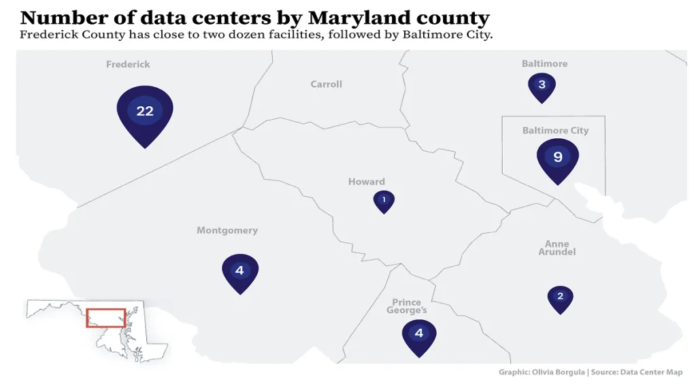
This is just one of many data centers operating in Maryland, particularly clustering around the Baltimore and Washington metropolitan regions. Critics argue that these facilities exert significant strain on the state’s already vulnerable energy grid while also contributing to escalating electricity prices.
As of October 2025, Maryland holds the 13th position in the nation concerning residential electricity costs, as recorded by the U.S. Energy Information Administration. The average residential electricity prices in the state surged approximately 18% between October 2024 and October 2025.
And this may just be the beginning. A 2024 report from the U.S. Department of Energy projected that data centers will account for approximately 7% to 12% of the country’s electricity consumption by 2028—a stark rise from the 4.4% seen in 2023. The share of the regional electricity grid providing power to Maryland and surrounding states is expected to triple from 2024 to 2029, as reported by grid operators.
Consequently, forecasts indicated that the regional electricity grid’s peak load could increase by 32 gigawatts between 2024 and 2030, enough energy to potentially power around 24 million homes.
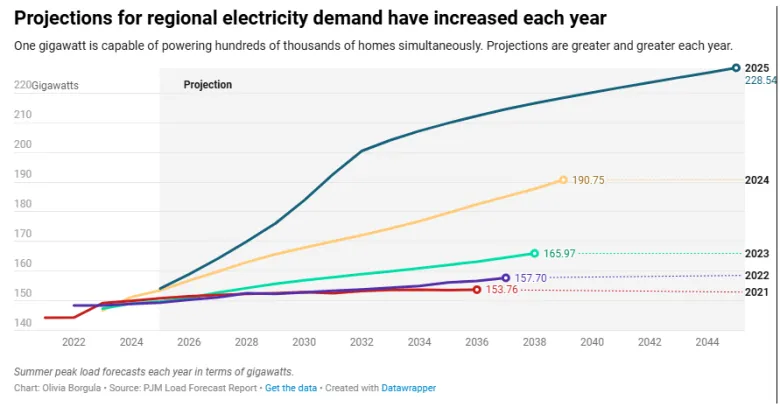
This surge in power demand, coupled with supply challenges and a protracted bureaucratic process for establishing new power sources, has led to increased electricity costs in Maryland—costs that are anticipated to rise further.
“Unlike a community hospital, a school, or even a highway, which everyone can utilize, these facilities exist primarily to generate profit for private companies, a burden that falls on the general public,” stated Steve Black, president of the Sugarloaf Alliance in Frederick County, which is part of the Maryland Data Centers Analysis Group.
Maryland’s Grid Operator
The surge in electricity costs can be attributed to the added strain that data centers impose on PJM Interconnection LLC—a regional entity tasked with coordinating electricity distribution across 13 states, including Washington, D.C., and Illinois. This organization operates with a board of 10 members who do not possess financial stakes in any of the companies that compete within PJM’s market.
A segment of ratepayers’ bills is attributed to the “supply” costs, influenced by PJM’s annual auction system. Here, power companies and businesses present bids based on the energy they can supply and the costs associated with maintaining reliable power during peak demands—a measure known as total capacity cost.
“PJM aims to ensure that on the busiest days, during the highest demand hours, there are no disruptions in service,” explained Michael Powell, a legal expert from the Energy and Environmental Practice Group at Gordon Feinblatt LLC.
In the 2024 PJM auction, capacity costs skyrocketed from approximately $2 billion to nearly $15 billion for the upcoming year. The latest auction to set rates for the 2026-27 period saw record costs exceed $16 billion, which might have escalated further had it not been for a cap requested by Pennsylvania Governor Josh Shapiro and supported by Maryland Governor Wes Moore.
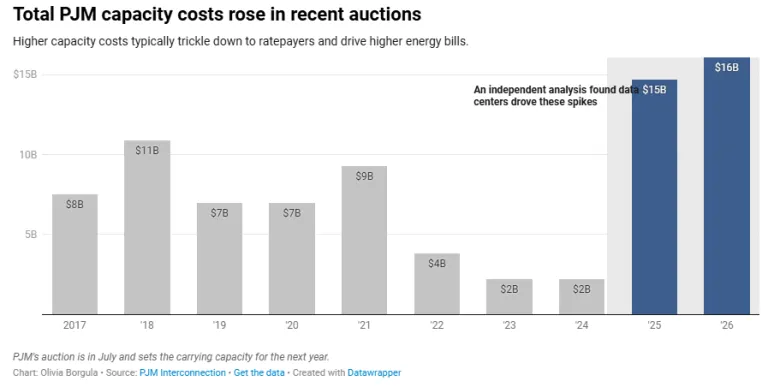
An analysis from the Independent Market Monitor revealed that the dramatic increases in capacity costs are largely a result of the existing and anticipated loads from data centers on PJM’s network, which is to be expected.
“If the data centers do not bear the financial burden, then the grid’s operational costs will inevitably be passed on to consumers,” warned Andrew Chien, a professor at the University of Chicago specializing in sustainable computing.
Boosting Supply
To manage the surging demand from data centers, one potential solution is to augment power sources. However, PJM has not increased its power generation capacity in alignment with peak demands as effectively as some other operators nationwide.
The timeframe for PJM to bring new energy generation systems online has ballooned from under two years in 2008 to over eight years currently.
In light of an increase in interconnection requests, PJM is faced with a backlog of pending power projects due to the exhaustive studies required prior to project initiation. This year, PJM plans to start reviewing applications submitted since 2022.
A bipartisan group of legislators from multiple states, including Maryland, advocated in November for more stringent regulations on PJM to protect consumers from rising rates.
In January, PJM’s board presented updated recommendations aimed at tackling the challenges posed by data center loads, including enabling these facilities to connect to the grid more efficiently if they can generate their own power.
Alison Williams, vice president of energy policy and research at b Strategic Solutions, and also a representative for the advocacy group Power for Tomorrow, expressed concerns that if reforms are not implemented, Maryland’s energy grid could face outages and service disruptions, along with further price surges.
“We recognize that demand will only continue to rise,” Williams noted. “What remains uncertain is how effectively PJM will address its supply issues. The time for solutions is now.”
Rising Electricity Costs
Electricity bills also reflect rates set by local utility companies, including Baltimore Gas and Electric, Delmarva Power, and Potomac Electric Power Company. These rates are computed based on delivery costs, infrastructure maintenance, and system repairs, with oversight from the Maryland Public Service Commission. Notably, utility rates had been climbing prior to the current surge in AI-driven data center demands.
Over the past 10 to 15 years, utility rates in Maryland have seen a steady increase, as noted in a report by the Office of People’s Counsel, an organization dedicated to advocating for Maryland’s residential customers. Various factors contribute to this trend, including rising temperatures and significantly increased energy delivery costs—some of which have more than doubled since 2012. Additionally, programs enabling utilities to rapidly recoup these costs contribute to the financial strain, according to the Office of People’s Counsel.
Black emphasized that while Maryland’s utility rates have been escalating, they are now primed to increase sharply due to high data center demand. “The spikes we will see are likely to surpass anything policymakers can manage effectively,” he remarked.
Strain on Maryland’s Grid
Alongside climbing prices, concerns over whether Maryland will receive sufficient electricity are mounting.
A specific incident provides a glimpse into the potential crisis: around 4,000 customers of BGE in Howard County experienced a sudden power disruption lasting 30 minutes in August, as infrastructure issues led to the offline status of certain Maryland generation plants.
Activists warn that such occurrences could become commonplace if power demands from data centers continue to overwhelm the state’s electrical grid. Maryland faces unique challenges, as it lacks the necessary energy infrastructure to meet its rising energy requirements, according to PJM.
Since 2018, Maryland has decommissioned 6,000 megawatts of power production capacity—that’s 75 times the output of Baltimore’s data center—and has only added back 1,600 megawatts. Currently, the state depends on other states for 40% of its annual electricity consumption, as reported by PJM.
In a bid to meet escalating energy demands, fossil fuel facilities are operating beyond their planned retirement dates. For instance, two Talen Energy-operated plants near Baltimore, originally scheduled to close in May 2025, will continue to run until 2029 to alleviate grid pressure.
According to an August 2024 report by the Office of People’s Counsel, consumers will be responsible for $629 million to keep these fossil fuel plants operational until Chicago-based Exelon, which oversees BGE, Delmarva, and Pepco, completes transition projects aimed at compensating for the lost power once those facilities shut down.
“The underlying issue is the imbalance between supply and demand that is postponing the retirement of these power plants,” pointed out Yueming “Lucy” Qiu, a professor at the University of Maryland focusing on energy and environmental economics. “Fossil fuel plants deliver consistent electricity, unlike renewable sources, which tend to be variable and unreliable.”
To address grid pressure, the Maryland Piedmont Reliability Project aims to facilitate easier electricity importation from neighboring regions, with a budget of $424 million. This project, led by a New Jersey-based invested utility, is designed to bolster transmission lines for Maryland.
However, the current pricing model for new transmission projects imposes heavier costs on areas closer to the load increase—even when they are situated in different states. For example, the expansion of data centers in Northern Virginia could lead to Maryland households incurring expenses for transmission projects designed to accommodate the associated demand, as highlighted by the Office of People’s Counsel.
New fossil fuel resources face opposition due to Maryland’s commitment to renewable energy, explains Black from the Sugarloaf Alliance. Additionally, constructing nuclear power plants in Maryland encounters challenges, given that they often need locations with lower population densities for evacuation protocols, which become increasingly scarce in a smaller state like Maryland. Similarly, finding sites with a reliable water supply for cooling is also a significant hurdle, as noted by Black.
Angie McCarthy, a conservation advocate from Nature Forward, stated that providing a significant power supply for data centers remains impractical. “If we aim to build a data center that requires one gigawatt of energy, we expect to meet that energy requirement in just a couple of years. Given today’s landscape, that expectation is unrealistic,” she remarked.
Future Expansion
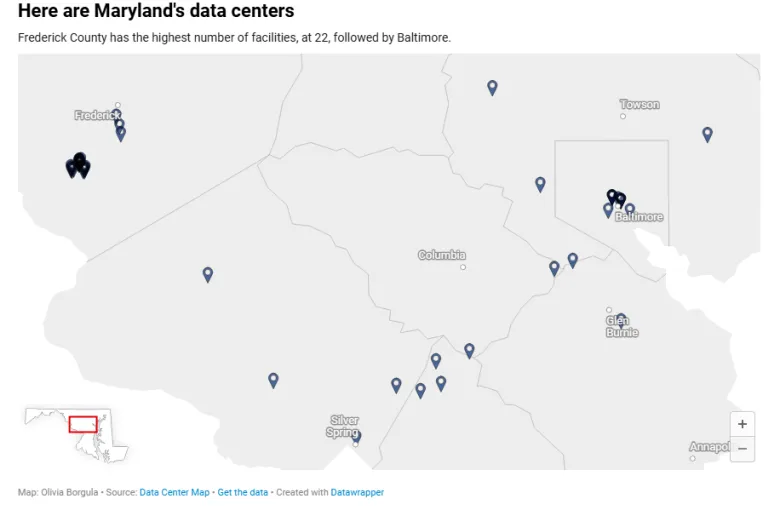
Maryland houses numerous data centers, according to data compiled by the industry itself, with plans to establish even more. Proponents of data centers argue that their presence is crucial for economic growth.
In Prince George’s County, there’s a proposition to convert an abandoned mall into 4 million square feet of data centers. Additionally, a $1.2 billion project in Frederick is in the works, which is set to create the largest data center campus in the state.
Proponents view data centers as a boon for Maryland’s technology sector, promising high-paying job opportunities and increased local tax revenues, particularly as the state confronts a budget deficit in the billions.
Kelly Schulz, CEO of the Maryland Tech Council, noted that the Frederick County project is estimated to yield $40 million in annual tax revenue. This equates to over 700 entry-level teacher salaries.
“I am optimistic about the financial benefits this project will bring to the county regarding tax revenues, and we cannot overlook the job opportunities it will create in Frederick County,” she emphasized.
Conversely, opponents of such developments voice concerns regarding accountability and the unknown long-term effects of data centers, which complicates governmental oversight. Chris Miller, president of the Virginia-based Piedmont Environmental Council, articulated that Maryland may face challenges similar to those that transformed Northern Virginia into the world’s largest hub for data centers.
“Data center companies need to bear the full brunt of both direct and indirect costs, including addressing environmental and community impacts. Costs need to be shared equitably across a global market,” he stated, adding that rising utility bills are a means of subsidizing the wealthiest corporations globally.