
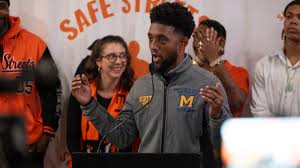
According to the office of Mayor Brandon Scott, Baltimore recorded 133 homicides in 2025, marking a remarkable 31.44% decrease compared to 2024.
In a joint statement with Baltimore Police Commissioner Richard Worley and Stefanie Mavronis, the Director of the Mayor’s Office of Neighborhood Safety and Engagement, Scott, a Democrat, emphasized that cooperation played a vital role in this steep reduction.
“While 133 homicides is still far too many, we are witnessing the positive effects of our efforts every day—not just through the statistics, but in the lives of the community we serve,” all three leaders declared in an announcement on Thursday. “Collaborative efforts are essential as we embark on a new year, reaffirming our dedication to eliminating violence in our city.”
The Scott administration initiated its Group Violence Reduction Strategy program in partnership with law enforcement and State’s Attorney Ivan Bates’ office in 2022. This initiative aims to allocate resources specifically to individuals who are at the highest risk of being involved in gun violence. As outlined on the website of the Mayor’s Office of Neighborhood Safety and Engagement, these gun violence reduction strategies are recognized nationally for their effective approach to reducing both homicide and non-fatal shootings with a proven track record.
Through this program, Scott has initiated violence interruption efforts, such as those conducted at the Center for Hope by LifeBridge Health, which oversees several Safe Streets locations in the city. Safe Streets employs a dedicated team of violence interrupters who work within communities to identify potential shootings and recognize individuals at greatest risk. These interrupters take on the role of mediators in personal conflicts, striving to avert retaliation and alter the behaviors of those prone to resorting to violence.
In addition to the collaborative efforts of Scott, Bates, Worley, and Mavronis, stakeholders also highlighted the significance of investments from state and federal leaders.
Scott received support from Gov. Wes Moore, a Democrat, whose administration re-established a partnership between the city and state to enhance the coordination of the Baltimore Police Department, Maryland State Police, and the Transportation Authority in crime-fighting efforts.
“Even though Baltimore City is witnessing some of the most significant drops in crime across the country, our work is far from finished,” Moore stated when the partnership was launched in September. “We are committed to enhancing public safety because our residents deserve it.”
State Sen. Cory McCray, representing Baltimore City, noted that federal and state support has enabled Baltimore to “overcome decades of insufficient investment.”
“In my district alone, four new recreational centers have opened or are in the process of opening. We’ve seen the first new public library in fifteen years debut, a new public school football stadium is being developed, major housing initiatives focused on home ownership are emerging, and Baltimore continues to lead as the fastest urban school district in America in constructing new educational facilities,” McCray shared in a text message on Friday. “When resources are increased and conditions that foster poverty are diminished, incidents of violence decrease.”
“What we are witnessing now illustrates the results of aligned leadership, intentional investments, and making opportunities accessible in every neighborhood,” he continued.
In the scope of public safety, Rosenberg from LifeBridge Health highlighted the influx of federal funding resulting from the bipartisan Safer Communities Act of 2022, which focused on reducing gun violence and enhancing community safety nationwide.
However, the Trump administration discontinued funding for this program in April, prompting concerns among violence interruption organizations about the sustainability of their progress and the potential for the city to revert to previous conditions.
“That’s essentially the crux of the matter. We are on the brink of potentially losing the funds necessary to continue our efforts,” Rosenberg stated. “While we have built a solid infrastructure, and everyone is working diligently, our organization experienced a loss of $1.2 million in funding in April.”
“Recouping these funds is not an easy task, and we will certainly make an effort,” he added. “However, the risk of setbacks is very real.”