
This article was republished with permission from WTOP’s news partners at Maryland Matters. Read the story at Maryland Matters.
Although the momentum for Democrats may have waned by Friday, they continue to maintain a favorable position, having reportedly unseated a Republican senator and gained two additional seats in the House of Delegates amid the counting of mail-in votes in Frederick County.
As per the latest updates released Friday evening, Democratic candidate Lara Westdorp has taken a lead over Senator Bill Folden (R-Frederick) with 28,803 votes for Westdorp compared to Folden’s 27,906 in the contest for the District 4 Senate seat.
Moreover, Democrats seem poised to claim two Republican-held delegate positions in District 4, including one left vacant by long-serving Del. Barrie Ciliberti, who opted not to seek reelection, as well as unseating Del. April Miller. While ballot counting may extend through Friday, if the current trends persist, Del. Jesse Pippy, the House Minority Leader, could be the sole Republican remaining in what had previously been an all-Republican district.
In the latest figures, Democratic challenger Jerry Donald led in the District 4 House race, garnering 27,936 votes, followed by Pippy with 27,344 votes and Democrat Andrew Duck, who received 27,181 votes.
These new results build on the Democrats’ strong performance on election night, where challengers succeeded in unseating Del. Stuart Schmidt (R-Anne Arundel) and Del. Barry Beauchamp (R-Wicomico). Statewide, as of Thursday night, there remained 269,342 mail-in ballots awaiting counting, according to the Maryland State Board of Elections.
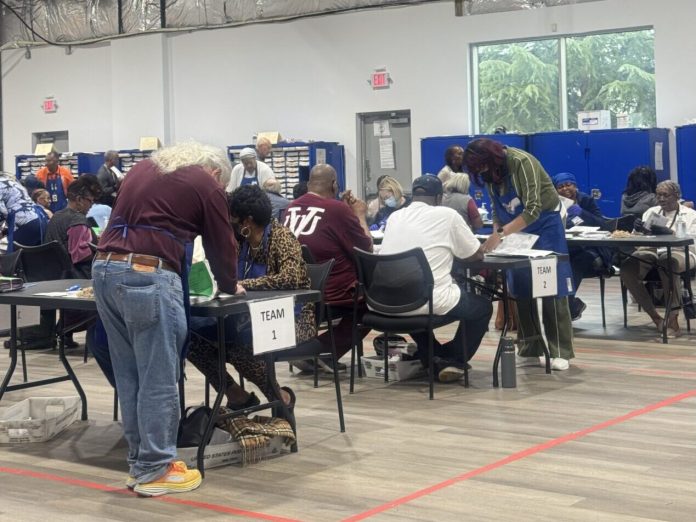
The latest figures from Frederick County reflect continued efforts by election officials to tabulate mail-in ballots, which tend to favor Democratic candidates. In a conversation earlier Friday, Folden refrained from conceding defeat but acknowledged the likelihood that mail-in votes would lean Democratic.
“I still have hope, but I’m also a realist who recognizes the significant message being sent nationwide in response to [Republican President Donald] Trump and his policies,” Folden stated Friday morning.
“Should the results ultimately not favor me, I have felt nothing but privilege in representing my district and the constituents of Frederick County. Serving them has been the greatest honor,” he noted, citing his advocacy for affordability, reduced energy costs, and property tax freezes.
Senate Minority Leader Steve Hershey (R-Upper Shore) expressed that District 4 was the seat they were most worried about protecting. However, he noted that the results for Republicans statewide were considerably worse than anticipated.
“We observed significant financial investment in the final week targeted at Democratic mail-in ballot initiatives,” Hershey remarked, noting that Republicans were unable to match the late spending within the district.
“We believe the efforts of the District 4 team were exhaustive,” Hershey commented. “In any other year, this race would have been concluded by now.”
In addition to the challenges posed by shifting voter preferences, Hershey suggested that Frederick County incumbents were also perceived as aligned with data centers, which may have negatively impacted their chances.
“I believe all elected officials in Frederick County were unfairly associated with the pro-data center label,” he explained.
Folden, who was first elected to the House in 2014 and was in his inaugural term as a senator, has a background as a retired police officer and is a committee member of Judicial Proceedings. He has often criticized the criminal justice reform measures advocated by Democrats.
Westdorp commented on her experience observing ballot processing for over five hours at the county’s Board of Elections office. She noted, “Ultimately, it comes down to the numbers, and the mail-in ballots are likely to favor my candidacy.” While acknowledging that challenging an incumbent was quite ambitious, she expressed a desire for change in her community.
“Everyone deserves a voice. While we may not always agree, I am open to explaining the rationale behind our decisions,” said Westdorp, who owns Frederick Reflexology. “Our current senator does not provide that level of engagement or accessibility to his constituents.”
‘People came out’
County election officials have until next Friday, November 13, to finalize the election results. Should additional time be required to count the ballots, local officials are obligated to notify the state Board of Elections beforehand.
Following that, state authorities will have until December 3 to certify the results, in what could be a noteworthy election cycle for potentially record-breaking gubernatorial results.
Unofficial updates released by the state on Thursday indicate that 1.9 million ballots had been counted, representing nearly 45% of Maryland’s 4.3 million eligible voters.
The final day of early voting this year set a record for voter turnout in gubernatorial elections, but State Board of Elections Administrator Jared DeMarinis stated on Friday that it would take some time to ascertain whether any other records were surpassed until all votes are fully counted.
“We welcomed nearly one million individuals for early voting, showcasing tremendous turnout,” DeMarinis remarked. “This is the foundation of our democracy — voter participation and ensuring that voices are heard in a secure environment is fantastic.”
He added that two post-election audits will initiate — a risk-limiting audit and an independent audit — prior to the State Board of Canvassers certifying results on December 3.
“Our objective is to guarantee that all Marylanders are assured of the accuracy of the vote count and the governorship reflecting the consent of the populace,” DeMarinis stated.
However, the election process was not seamless at all polling locations. After several hours of delays, a circuit judge in Prince George’s County denied an urgent request to extend voting hours at the Robert J. DiPietro Community Center in Laurel.
Prince George’s Election Administrator Wendy Honesty-Bey disclosed on Thursday that election officials should call the Board of Elections beforehand if they require additional materials like ballots or scanners before polling day. A call was made from the Laurel precinct “on the day of” requesting more ballots and an added scanner.
When wait times at the community center extended for hours, county and state officials advised online that voters seeking to avoid the lengthy lines could cast mail-in ballots at the Board of Elections office in Largo or utilize provisional ballots at four other sites in the Laurel vicinity.
Honesty-Bey indicated that the county might surpass the record of 24,000 provisional ballots counted during the 2024 presidential election, but not exclusively due to the situation at the Laurel precinct.
“We experienced a high turnout at the Robert DiPietro Community Center, which was commendable. People were enthusiastic about voting,” she emphasized.
Regarding the Laurel polling location, she noted, “We need to analyze what transpired. This should not occur again.” YOU MAKE OUR WORK POSSIBLE.SUPPORT
DeMarinis stated that his office will explore ways to improve assistance for local jurisdictions going forward.
“There’s always a chance to refine the process and enhance its effectiveness,” he affirmed.
Regardless of the outcome in Frederick County, Westdorp shared her plans to depart for a vacation right after the ballot certification, a trip that her husband, who also led her campaign, organized this past summer.
“I am heading to Puerto Rico,” she revealed. “After the primary, my husband insisted, ‘We must celebrate away from here. Get ready for a flight.’ It’s essential to nurture and maintain a strong relationship.”
— This report includes contributions from Maryland Matters reporter Bryan P. Sears.