
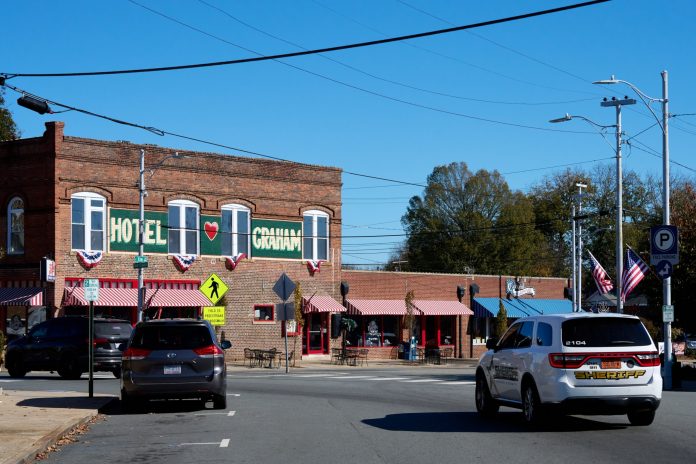
GRAHAM, N.C. (AP) — During his campaign for sheriff in North Carolina, Shannon Long faced hurdles as he went up against a longtime incumbent closely associated with the Trump administration’s stringent immigration policies. He discovered that his campaign vehicle, prominently marked with “sheriff,” deterred some voters from engaging with him.
Long emphasized that trust had severely eroded between law enforcement and Alamance County’s expanding Latino community. This lack of trust, he noted, made it challenging to even get some people to converse with him.
“They’ve been living in fear. They feel voiceless. Many have experienced suppression, oppression, and even depression. They perceive themselves to be part of a community where they don’t belong,” said Long, who has backgrounds as a pastor, business owner, and former sheriff’s deputy. His comments came two weeks after he unseated Republican Sheriff Terry Johnson in an election where concerns about immigration enforcement and the treatment of Latino residents featured prominently, according to various activists, voters, and local leaders.
Johnson stood out as one of a handful of sheriffs across the country who were defeated by challengers who criticized their cooperation with President Donald Trump’s aggressive stance on mass deportations. While the number of such elections remains limited, the outcomes could pose challenges for other sheriffs who are seen as actively participating in Trump’s immigration policies, potentially affecting agreements that have become key components of the administration’s initiative.
Johnson was one of the initial sheriffs to grant his deputies the authority to enforce federal immigration laws through a 287(g) agreement with U.S. Immigration and Customs Enforcement. In contrast, Long, running as an independent candidate, pledged to reduce collaboration with ICE. This federal agency continues to depend on such agreements to enhance its arrest statistics, even after receiving a significant $75 billion from Congress and hiring around 12,000 new officers.
Under the Trump administration, the number of 287(g) agreements with state and local organizations surged to over 2,700, a stark increase from just 135 at the beginning of his second term. Primarily located in the Southern U.S., these agreements have empowered more than 29,000 local law enforcement officials and resulted in over 6,600 arrests in July alone, amounting to roughly 15% of all ICE arrests, according to analyses by the advocacy group fwd.us.
A review by the AP of approximately 250 sheriff elections held this month, in which 287(g) agreements were an issue, revealed competitive races in states such as Indiana, Maryland, North Carolina, and Wisconsin where candidates faced defeat due to their ties to ICE. While many sheriffs were unchallenged this election cycle, the influence of ICE agreements could resurface in two years when sheriffs from states with substantial numbers of 287(g) agreements, like Florida and Texas, are scheduled to run for re-election.
A new sheriff is coming to ‘No Chance Alamance’
Alamance County, a consistent Republican bastion with a population of nearly 200,000 located between Greensboro and the Research Triangle—including Raleigh, Durham, and Chapel Hill—has seen an increase in political competitiveness largely due to its diversifying demographics. The area reported only 750 Hispanic residents in the 1990 census, which swelled to nearly 25,000 by 2020. A representative from the sheriff’s office confirmed that while the county still participates in the 287(g) program, it ended an agreement last year to detain ICE detainees.
Johnson, who identifies as white, first took office in 2002 and has been regarded as both a prominent and controversial figure. He has consistently claimed to be welcoming to lawful immigrants while denying ongoing accusations—echoed in a decade-old Justice Department lawsuit that concluded with a settlement—that his office engaged in racial profiling against minority residents.
The county gained the nickname “No Chance Alamance” due to a widespread perception of unjust policing and insufficient political representation for Black and Latino residents, as pointed out by school board member Seneca Rogers.
Initially, Johnson acknowledged via a phone conversation that immigration policies might have influenced his electoral defeat. However, in a later brief discussion, he suggested that they likely played a minimal role and pointed to his lengthy tenure and a challenging national political climate that was particularly brutal for Republicans, especially in North Carolina, where Democratic former Governor Roy Cooper flipped a U.S. Senate seat by nearly 20 percentage points. He insisted he has always abided by legal guidelines and prioritized public safety.
Activists and long-term residents reported that the Latino community, along with to some extent the Black community, felt apprehensive about engaging with the sheriff’s department, believing that non-white individuals were more likely to face traffic stops or detentions. Some residents even voiced fears about calling 911 or commuting to work, according to community organizer Leslie Arevalo.
Voter Renee Russell noted that the sheriff’s collaboration with ICE painted an unwelcoming image of Alamance County, expressing her enthusiasm for new leadership. Local media outlets reported that Long will be the county’s first Black sheriff.
Nonetheless, Republican state Senator Amy Galey, whose district encompasses Alamance County, defended Johnson’s record, highlighting his efforts to enhance training opportunities and mental health services. While she felt immigration did not significantly factor into the race, she speculated that hardline ICE tactics employed elsewhere may have exacerbated general concerns regarding law enforcement.
Candidates who backed ICE cooperation lost elsewhere
Frederick County, Maryland, which is located northwest of Washington, D.C., also had a longstanding relationship with the 287(g) program. Since 2008, the county has detained and transferred 1,884 individuals to ICE, stated Republican Sheriff Chuck Jenkins. However, a significant change occurred this year when Democratic Governor Wes Moore signed a law prohibiting immigration enforcement agreements with the federal government.
Public opinion had shifted against Jenkins, who argued that the program contributed to community safety but conceded it ultimately affected his chance for re-election. He lost to Democrat Karl Bickel, a retired employee from the U.S. Department of Justice who had previously been defeated in four elections against Jenkins and pledged to avoid cooperation with ICE.
“People are increasingly disillusioned with the sheriff’s negative attitudes toward immigrants,” stated retired social worker Carol Antoniewicz, who supported Bickel through the distribution of emails, social media outreach, and campaign materials.
In Wisconsin’s Winnebago County, the arrest and detention of a schoolteacher by ICE shortly before Election Day provoked backlash against anyone perceived as supportive of immigration authorities, including a Republican candidate looking to succeed a retiring sheriff.
“Any kind of perceived alignment with ICE is now seen as a liability,” noted Molly Smiltneek, a local advocate and immigration attorney who participated in a vigil for the detained teacher.
While the sheriff’s department was not involved in the teacher’s arrest, its 287(g) agreement emerged as a focal point during the campaign, ultimately benefiting Democrat Jason Rippl, who vowed to terminate it.
A newly elected sheriff seeks a better community partnership
Long, who previously served as a deputy in a neighboring county in North Carolina, affirmed that he would enforce the law and hold offenders accountable in his new position. However, he specified that he would not engage in the 287(g) program.
He has already initiated meetings with the Latino community, aspiring to cultivate new relationships and foster trust.
“I want them to view the sheriff’s office as a community partner, reassuring them that they have a voice… There’s no reason for anyone to live in fear,” he concluded.
___
Schuettler reported from Phoenix and Lieb from Jefferson City, Missouri. Associated Press journalist Allen G. Breed contributed from Graham.
___
Schuettler is a corps member for The Associated Press/Report for America Statehouse News Initiative. Report for America is a nonprofit national service program that places journalists in local newsrooms to focus on underreported issues.