
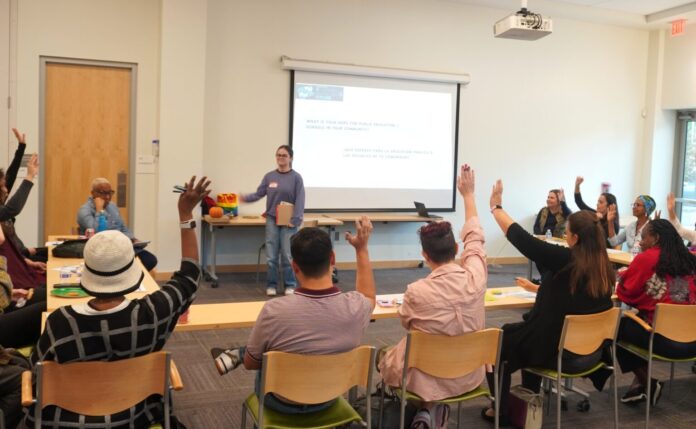
At a recent gathering focused on Maryland’s comprehensive education reform initiative, attendees acknowledged the impending budget shortfall while discussing the challenges faced in implementing the Blueprint for Maryland’s Future. However, these issues didn’t dominate the conversation during the meeting held on Tuesday evening.
“They better not cut it,” asserted Cheryl McLeod from Howard County after participating in a two-hour discussion.
McLeod, who is affiliated with the nonprofit organization World Class Grads, joined approximately two dozen parents, educators, and community leaders at the Elkridge Branch Library to engage in a dialogue about educational improvements, particularly focusing on the Blueprint initiative.
This meeting was part of ongoing efforts by the Blueprint Coalition, a group comprising nonprofit organizations, community leaders, and education advocates dedicated to supporting the implementation of the ambitious, decade-long, multibillion-dollar plan. As the initiative enters its fifth year, it increasingly faces scrutiny from lawmakers who are tackling budget constraints in anticipation of the 2027 legislative session.
The coalition has already organized community meetings across Montgomery and Prince George’s counties, with another session planned for Baltimore City and at least one virtual meeting scheduled in the upcoming months. The Maryland General Assembly is set to commence the 2027 session on January 13.
Kenzie Funk, a policy advocate for Strong Schools Maryland, emphasized the importance of maintaining communication leading into the legislative session, stating, “The main point of this conversation is that we stay connected and continue talking about it.”
During the meeting, numerous participants discussed the challenges their communities face regarding the Blueprint. Key issues included difficulties in hiring and retaining educational staff, inadequacies in teacher preparation programs at the higher education level, and increasing class sizes.
A summary presented during the session highlighted the five foundational pillars of the Blueprint: early childhood education; a high-quality and diverse cadre of teachers and leaders; college and career readiness; additional resources to enhance student achievement; and governance and accountability mechanisms.
Attendees were aware of the state’s forecasted $3 billion budget deficit for the upcoming fiscal year, with roughly $1.8 billion of that amount linked directly to education under the Blueprint, as reported by the Maryland Association of Counties (MACo).
Moreover, the anticipated budget shortfall for fiscal 2028 marks the first occasion when the expenses associated with the Blueprint will surpass the dedicated revenues. To address this discrepancy, the state may need to utilize the general fund, particularly as a pioneering digital ad tax intended to finance the Blueprint remains in legal uncertainties.
In response to the financial challenges, at least one group plans to propose a solution to the General Assembly aimed at generating additional revenue.
Fair Share Maryland, a coalition representing 75 organizations, is set to renew its push for the Fair Share Act, a tax package designed to reform corporate income tax reporting, increase taxes on the wealthiest Marylanders, and bolster auditor numbers, in addition to raising capital gains surcharges. Advocates argue that its full implementation could generate approximately $1.6 billion.
“These are the types of adjustments we are aiming for to help increase revenue,” stated Kali Schumitz, communications director with the Maryland Center on Economic Policy, a member of the Fair Share Maryland coalition. “We have already faced several rounds of state budget cuts impacting numerous areas.”
Some proposed changes, whether minor or significant, are currently under evaluation.
The Blueprint for Maryland’s Future Accountability and Implementation Board, responsible for overseeing the decade-long initiative, is slated to convene on October 15 to discuss and potentially vote on suggested modifications.
Among the proposals in a recently released 15-page document is an increase in the annual funding for the prekindergarten expansion grant program, for which the General Assembly allocated $10 million in this fiscal year’s budget.
Another suggestion involves permitting health assistants to lead after-school programs under the oversight of a registered nurse. However, the AIB document clarifies that the Maryland Board of Nursing will determine if a health assistant can lead such initiatives even when supervised by a registered nurse.
While the Blueprint Coalition is eager to work collaboratively with legislators, members expressed that any cuts to the Blueprint are not a part of their agenda.
“Yes, it’s not perfect, but we need that funding to move forward, and then we can build upon it,” stated Riya Gupta, executive director of Strong Schools Maryland. “Without that foundation, we aren’t progressing. We risk taking steps backward, and someone’s child ultimately loses out.”