
This article was republished with permission from WTOP’s news partners at Maryland Matters. Read the story at Maryland Matters.
The Supreme Court of Maryland delivered a significant ruling on Thursday evening, allowing a proposed ballot question regarding congressional redistricting standards to be presented to voters in November. This important decision comes on the heels of legal challenges from state Republicans concerning the amendment’s language to the Maryland Constitution.
The court’s order overturned earlier judgments from two lower courts that had backed the Republican stance against the ballot proposal. With an impending deadline for finalizing the ballot for printing, this ruling underscores the urgency of the matter.
In an eight-page majority opinion, Chief Justice Matthew J. Fader supported the findings of judges from Anne Arundel and Dorchester counties, who ruled that the wording of the ballot question as crafted by the Maryland General Assembly was misleading, thereby violating due process standards.
Chief Justice Fader specifically criticized the phrase “applicable federal laws” used as a criterion for determining congressional district boundaries, noting that it could create confusion among voters.
However, he also contended that the judges in the lower courts were mistaken in their decision to issue injunctions preventing the ballot question from going forward.
“A suitable remedy in this case, which respects the General Assembly’s authority to propose constitutional amendments to Maryland voters, is to substitute the purpose paragraph for the text as it currently stands,” read the majority opinion.
In contrast, Justice Steven B. Gould, along with Senior Justice Glenn T. Harrell, dissented, expressing a strong opinion against the majority’s decision. Justice Gould argued that he would have upheld the lower courts’ rulings, fiercely criticizing the language of the ballot question crafted by the Democratic majority of the legislature.
“I have doubts about whether the Election Law Article even permits us to draft ballot language,” Gould stated. “If we had such authority, I find it perplexing that we would intervene when a majority of the Court recognizes that the General Assembly has submitted a misleading question to the electorate,” he added.
Gould asserted that the General Assembly should be accountable for creating a misleading question instead of relying on the court to amend it.
He further claimed that the newly proposed question by the majority remains unclear, positing that “voters in Maryland would not comprehend that the criteria being removed include the protections outlined in the Declaration of Rights, which safeguard Maryland residents against overreach by the government.”
Justice Gould warned that if voters pass the amendment in November, the “Declaration of Rights would no longer serve as a benchmark for evaluating congressional districting plans.”
He cautioned that this outcome would strip Maryland residents of their ability to challenge districting plans that could potentially discriminate against religious minorities or retaliate against individuals for their political affiliations or expressions. “These protections should not be deemed redundant,” Gould noted.
Both Justices Gould and Harrell supported the conclusion of the lower courts, stating that the legislative body had failed to meet a legal deadline for approving the proposed ballot language and improperly included two subjects within a single ballot measure.
Nonetheless, the majority denounced the circuit courts’ claims regarding these alleged errors by the General Assembly. This order only reflects a portion of the majority’s reasoning on the appeal, with Chief Justice Fader indicating that a comprehensive opinion will be made available at a later date.
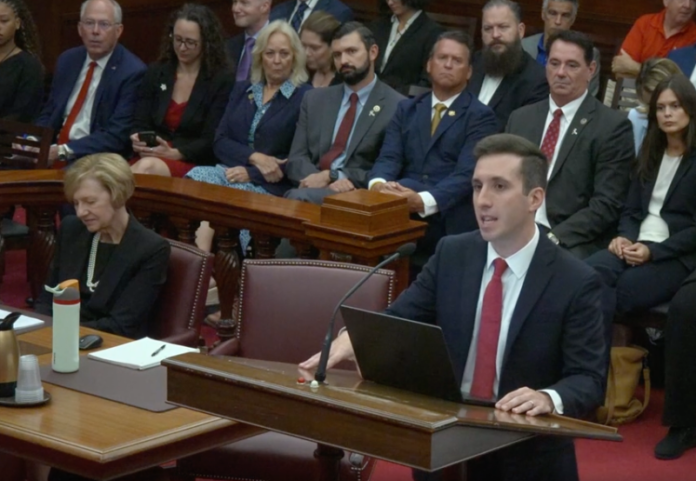
The decision followed a two-hour hearing held on Thursday, exactly one month after the introduction of House Bill 2100 in the House of Delegates, which triggered a quick two-day special session for the Maryland General Assembly.
During the hearing, justices questioned both parties extensively, mindful of the approaching deadline for election officials to finalize the November ballot.
This session and deliberation occurred precisely one month following HB 2100’s introduction in the House, marking a rapid sequence of events related to congressional redistricting.
The amendment proposed by the Democratic supermajorities in both the House and Senate passed easily along party lines.
This initiative seeks to override a 2022 ruling by Judge Lynne Battaglia in a congressional redistricting case, which had linked the redraw of congressional districts to the requirements for compactness and contiguity outlined in the Maryland Constitution.
Judge Battaglia’s ruling was labeled as unprecedented, as such standards had predominantly been considered applicable only to state legislative districts.
However, concerns arising from the Battaglia decision prompted Senate President Bill Ferguson (D-Baltimore City) to halt a new congressional map that was previously approved by the House in February, while several states hastened to redraw their congressional districts ahead of the fall elections.
Subsequent developments in national politics, including a U.S. Supreme Court ruling that weakened racial protections within the historic Voting Rights Act, influenced Ferguson’s reversal, leading him to support a special session aimed at amending the Maryland Constitution to nullify the Battaglia ruling. As this is a constitutional amendment, it requires voter approval.
Shortly after the conclusion of the special session, two legal challenges to the proposed amendment were launched—one in Annapolis and the other in Cambridge.
Republican opposition has manifested in both the legislature and the courts, with criticisms of the amendment centered on its potential to facilitate mid-cycle redistricting by Democrats as early as the next year, possibly skewing all eight of Maryland’s congressional seats in favor of the Democratic Party.
Currently, Congressman Andy Harris (R-1st), who represents the Eastern Shore, stands as the only Republican member of Congress from Maryland.
In recent expedited decisions from both the Annapolis and Cambridge courts, judges referenced legal deficiencies in the legislative process, noting missed statutory deadlines as well as violations of the Maryland Declaration of Rights, which raised concerns about due process and whether voters would recognize that passage of the amendment would effectively eliminate their ability to contest any new congressional map.
The rulings from the circuit courts were promptly appealed to the Supreme Court for further review.