
Contiuing our coverage, the National Park Service issued a special use permit that enables D.C. Water to kick off the initial phase of its environmental restoration initiative.
Environmental restoration commences as work focuses on the fractured Potomac Interceptor sewer line.
On Tuesday, rain impeded D.C. Water’s environmental restoration efforts along the C&O Canal and Potomac River. Nonetheless, cleanup operations are progressing following a significant sewage spill that occurred in January.
The recent special use permit from the National Park Service has paved the way for D.C. Water to begin the first phase of its restoration strategy.
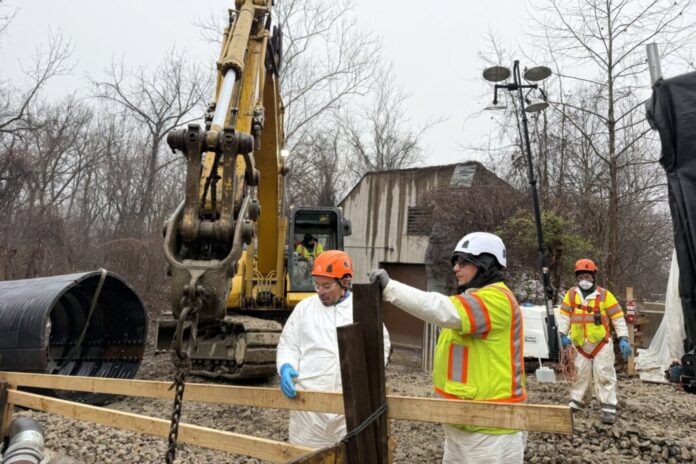
Sherri Lewis from D.C. Water provided a tour of the project site, highlighting areas where polluted soil and debris have already been excavated. She also showcased the fencing installed to prevent any washed-out materials from re-entering the drainage channel.
“Currently, you won’t see any active work because we are unable to proceed during rainy days,” Lewis explained.
Despite the inclement weather, piles of contaminated material have been excavated and are prepared for removal.
According to Lewis, the restoration will take place in multiple phases.
“Our first steps involve clearing away the brush, debris, and any contaminated soil. Following that, we aim to replant vegetation as part of our second phase,” she detailed.
In certain areas of the worksite, trees have been flagged for removal as needed.
Lewis emphasized that D.C. Water is dedicated to restoring the area to its previous state as closely as possible.
“We are just as invested in the health of the Potomac as anyone else, and our goal is to restore this shared treasure for our community,” she stated.
As the cleanup progresses, weather permitting, significant underground repair work continues.
Lewis mentioned that teams are currently preparing the upstream portion of the damaged sewer line for the application of geopolymer, a concrete-strengthening material that will be sprayed onto the inside of the pipe for stabilization.
“Cleaning has already been completed. They power washed the interior to ready it for the geopolymer application,” she added.
She noted that the geopolymer is robust enough to provide an urgent fix to the pipe, while longer-term plans entail slip lining the pipe with fiberglass.
“Layers of geopolymer will be sprayed on until the desired thickness is achieved. This will significantly fortify the pipe and rehabilitate that section until we can proceed with the slip lining,” she explained.
Once this phase is complete, efforts will shift downstream, where crews continue to clean up the debris resulting from the collapse.
“We are still addressing the downstream section of the pipe,” Lewis remarked.
The collapse caused a severe blockage within the Potomac Interceptor. Lewis pointed out that crews had to remove a substantial accumulation of rock and debris, cutting off the crown of the pipe in the process.
“After removing the crown, we successfully cleared about 50 feet of rocks and debris from within the pipe,” she noted.
To prevent sewage from entering the Potomac River during these ongoing repairs, D.C. Water has significantly increased the pumping capacity at the site. Lewis indicated that the team nearly doubled their pumping capabilities, maintaining operations around the clock.
“We must continuously pump because the ground is highly saturated,” she explained.
Despite these obstacles, Lewis is optimistic that the emergency repairs will be completed by mid-March, although the full environmental restoration process is expected to take longer.