
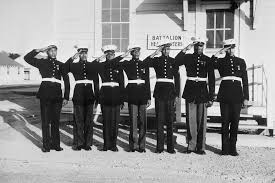
BALTIMORE COUNTY — In the history of the United States Marine Corps, there was a period of segregation that preceded its integration. A group of courageous men played a pivotal role in changing this narrative by training at a lesser-known facility known as Montford Point.
The Montford Point Marines hold the distinction of being the first African American men to break the barriers of segregation within the Marine Corps during World War II, long before civil rights reforms transformed the nation.
While integration efforts in the Army, Navy, and other military branches were already underway, the Marine Corps lagged behind, maintaining segregation longer than any other service.
This gradually changed when President Franklin Delano Roosevelt enacted Executive Order 8802, which prohibited racial discrimination in defense industries and laid the foundations for the desegregation of the military.
As a direct consequence, around 20,000 African American men were enlisted at Montford Point Camp located near Jacksonville, North Carolina, from 1942 to 1949.
However, what awaited them was far from hospitable.
“There was no infrastructure. There were no buildings,” remarked O’Neil Johnson Jr., president of the Baltimore chapter of the National Montford Point Marine Association. “They initially lived in tents and had to construct the camp themselves.”
The Montford Point Marines not only trained there but also built the very base they operated from, all while facing numerous challenges such as mosquitoes, rodents, snakes, and harsh environmental conditions, compounded by the discrimination they encountered regarding their competencies.
Despite facing persistent stereotypes, Johnson emphasizes that these men were far from unskilled.
“They were highly educated,” he explained. “Many were professors, lawyers, and other professionals who enlisted because of their love for America, even when the country often didn’t reciprocate that love.”
Johnson elaborates that Black Marines frequently had to endure more rigorous training than their white peers to validate their worthiness.
“Acceptance was a gradual process,” he noted.
That shift in acceptance began to materialize during overseas combat, particularly in Saipan and the Mariana Islands, where the Montford Point Marines showcased remarkable performance. Their valor compelled Marine Corps leadership to recognize their expertise, discipline, and readiness.
Ultimately, their achievements contributed significantly to the full integration of the Marine Corps, paving the way for future generations of service members.
Today, the National Montford Point Marine Association strives to ensure that this vital history is preserved.
With nearly 29 chapters across the United States, including one in Baltimore, the organization is dedicated to educating the public, honoring both living veterans and their fallen comrades, and preserving the legacy of the original Montford Point Marines.
Today, only a small number of the original Montford Point Marines remain alive, many now in their 90s and even over 100 years old.
In 2010, Congress awarded the Congressional Gold Medal to honor the Montford Point Marines, a measure that was signed into law by President Barack Obama. Although thousands attended the inaugural medal ceremony, Johnson mentions that many families are still awaiting acknowledgment.
“We are still on the lookout for Montford Point Marines to present them with the Congressional Gold Medal,” Johnson stated. “This extends to descendants, spouses, siblings, cousins—any next of kin.”
So far, only a small fraction of the estimated 20,000 Montford Point Marines or their family members have received this honor.
Having served over three decades in the Marine Corps, including deployments during Desert Storm, following 9/11, and in Afghanistan, Johnson reflects that he only learned about the Montford Point Marines in 2010.
“Once I discovered their story, I became fully invested,” he recounted.
To him, their legacy is exceptionally personal.
“We stand on their shoulders,” Johnson said. “Without the original Montford Point Marines, my opportunity to serve would not have existed.”
Though their story is often spotlighted during Black History Month, Johnson underscores its broader implications.
“This is not merely Black history,” he asserted. “Black history is an integral part of American history.”