
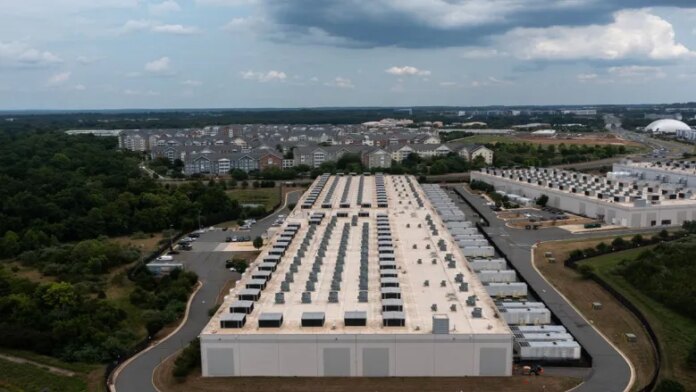
Recent proposals for development seem to be emerging at an impressive pace.
Locations such as an empty Social Security building in Baltimore County, a decommissioned power plant in Montgomery County, and a former mall site in Prince George’s County have become focal points for potential new projects. This is in addition to a data center campus that has been underway for some time on a previously industrial site in Frederick County.
It appears that large-scale data centers, which have established a significant footprint in nearby Virginia, are poised to increase their presence in Maryland in the coming years. However, the state currently lacks a unified policy to manage the influx of these energy-intensive facilities. Local authorities predominantly hold the reins to approve or reject these developments through their zoning regulations.
“Local governments can make decisions that have a state-wide impact,” stated Dave Arndt, co-chair of the Maryland Legislative Coalition Climate Justice Wing, emphasizing his focus on data centers. “If they approve a massive hyperscale data center that requires new power lines and a substation—using as much energy as the city of Baltimore—that will inevitably raise our energy costs.”
As the upcoming General Assembly session approaches, data center regulations are expected to attract considerable attention. Maryland’s grid operator has been sounding alarms about the projected energy demands from these facilities, warning that such increases could further escalate energy prices.
A notable instance occurred during December’s special session, when lawmakers overrode Governor Wes Moore’s (D) veto of a study evaluating the impact of data centers on the state, one of several vetoed by the governor.
While discussing this study on the Senate floor, Senator Charles Sydnor (D-Baltimore County) revealed that his office had become aware of a data center proposal in Woodlawn—located in his district—over the summer, prompting extensive research and fact-finding.
“Experts are stressing that across the nation, including here in Maryland, we are hastily approving data center projects through a disorganized process that lacks adequate regulatory safeguards, potentially harming our communities,” emphasized Sydnor.
He voiced concerns that benefits from data center projects “often only accrue to the wealthy,” while the associated costs “are distributed among the general public.”
Senator William G. Folden (R-Frederick), advocating for the governor’s veto override, highlighted the tangible effects looming data centers have on localities. “In Frederick County, we are at the forefront of developing our data center capabilities, with a 2,200-acre parcel currently under consideration,” he stated.
In the previous legislative session, lawmakers incorporated several data center regulations into a broader package focused on energy reforms. For example, one provision mandated that electric utilities create specialized rate schedules for large-load consumers, including data centers, contingent upon approval from the Maryland Public Service Commission (PSC).
“The General Assembly intends that residential electric customers in the state should not bear the financial risks associated with large-load customers connecting to the electric grid,” stated this bill, which Governor Moore signed into law in May.
However, it is evident that more regulatory changes are necessary.
Governor Moore advocates for the state to embrace data centers but insists that such expansion must be met with prudence.
“I reject the misleading dichotomy often presented: either we allow Big Tech to operate without restraint and become like Northern Virginia, or we completely stifle economic development within the state,” Moore declared during a recent press conference. “Neither of these extremes is a viable solution.”
In 2024, Moore’s administration proposed legislation exempting the diesel-powered backup generators used by data centers from scrutiny by the PSC, which was successfully passed.
Recent comments from Moore suggest he envisions a collaborative approach, where state officials engage with the affected communities, local authorities, and environmental organizations to establish guidelines for data centers looking to operate in Maryland. This would include incorporating “best practices,” such as having their own power generation systems.
Challenges for Data Centers at PJM
Under existing policies, all electricity ratepayers collectively share the costs of system maintenance and expansion. However, there is increasing pressure to require very large users, like data centers, to cover their necessary power increases.
PJM Interconnection, the operator of the largest electricity grid in the United States—which encompasses Maryland, Washington D.C., and multiple other states—is currently evaluating possible policy adjustments regarding data centers. A decision is anticipated in January before the Federal Energy Regulatory Commission takes final action.
One proposal from state governors, including Moore, aims for PJM to incentivize data centers to establish their own power generation capabilities. Alternatively, a proposal from state legislators, including several from Maryland, suggests that PJM should limit power provided to data centers during emergencies if they do not have their own generation systems.
The urgency for regulatory reform is palpable. During its December energy capacity auction, PJM did not acquire the total amount of energy it deemed necessary for the delivery year 2027-2028, with the anticipated demand from data centers being a significant contributing factor.
This shortfall does not imply that the grid will be unable to serve its customers during that delivery year. However, PJM aims to maintain a 20% reserve margin for power system emergencies, yet only managed to secure 14.8%.
The deficit arose as PJM anticipates an increase of approximately 5,100 megawatts of demand from data centers during the upcoming years. Yet there are concerns that this demand might be overstated, as data centers often negotiate with multiple power companies regarding the same projects.
PJM officials are hopeful that their policy modifications will mitigate this shortfall by lowering the anticipated load from data centers.
“We believe that various factors will bring us closer to required standards by the scheduled delivery year due to expected changes between now and 2027,” stated Stu Bressler, executive vice president of market services and strategy at PJM.
Maryland Is Not ‘Negotiating With an Empty Hand’
At the same time, Maryland is exploring its own potential policy changes.
Senator Katie Fry Hester (D-Howard and Montgomery) is working on legislation that would mandate all data centers of a certain scale to acquire a certificate to operate from the PSC.
She asserts that this bill would enhance state-level oversight concerning energy consumption, differing from the current permitting process managed by the Maryland Department of the Environment, which primarily focuses on emissions and site assessments. It would also establish a central repository for data center proposals, improving tracking efficiency.
“This is essentially a transparency initiative, ensuring all relevant information is centralized at the state level,” Hester explained.
Delegate Lorig Charkoudian (D-Montgomery) is also developing a bill aimed at encouraging data centers to reduce their power consumption during peak demand periods, such as excessively hot days when air conditioner usage is at its highest. She emphasized that the electrical system is designed to withstand peak loads, even though it is often under-utilized throughout the rest of the year.
“I’m concentrating on how to ensure that as new data centers emerge in Maryland, they contribute positively during the 100 hours each year when their operations could escalate expenses,” Charkoudian remarked.
Data centers could potentially lessen their energy use by scheduling specific work for non-peak hours or pre-cooling their facilities to minimize the need for cooling during peak times when the grid is most strained, she added.
Charkoudian’s legislation would also provide incentives for data centers to establish battery energy storage units in their vicinity, allowing them to utilize stored energy during peak demand periods.
Arndt from the Climate Justice Wing hailed Charkoudian’s initiative as a “win-win-win situation.”
“They [data centers] remain operational, the grid stays functional, and we benefit by not having to construct new peaker plants,” Arndt stated, referencing facilities that activate during peak demand times.
However, he emphasized the importance of ensuring that these bills mandate data centers to utilize clean energy sources for their backup power during peak periods, rather than resorting to fossil fuel generators.
“We aim to avoid diesel generators operating for extended periods in communities simply due to energy shortages,” Arndt emphasized.
Angie McCarthy, a conservation advocate at Nature Forward, expressed support for Charkoudian’s legislation, acknowledging potential opposition. She anticipates that data center developers might contend that stringent regulations could drive them to seek locations in neighboring states like Pennsylvania and Ohio instead of Maryland.
“From our perspective, Maryland is an attractive location for data center development, given our proximity to fiber-optic networks and other infrastructures established in Virginia,” McCarthy argued. “We are not negotiating from a position of weakness.”
The Maryland Tech Council, representing technology enterprises, has recently underscored the significant economic contributions data centers can provide to the state.
A typical 800,000 square-foot data center is estimated to create around 5,000 jobs during the construction phase, along with $775 million in economic activity and $18 million in state tax revenue, as stated in an August report from the Tech Council. Once operational, such a facility can generate approximately 500 permanent jobs, $31 million in yearly salaries, and $14 million in annual state tax revenues, according to a study conducted by the Sage Policy Group, a Baltimore-based economic research firm led by Anirban Basu.
A more recent report focused on Prince George’s County, highlighting that a “mid-sized” data center project could yield over $1 billion in economic activity during its construction phase, alongside $20 million in annual tax revenue for the county.
“As other states actively compete for data center investments, Maryland cannot afford to remain idle,” the Tech Council’s report stated. “By fostering responsible data center development, Maryland can tackle its immediate fiscal and economic challenges while positioning itself as a leader in the digital economy for many years to come. The time to act is now, before this opportunity, like many others, is lost to neighboring states offering more favorable business climates.”