
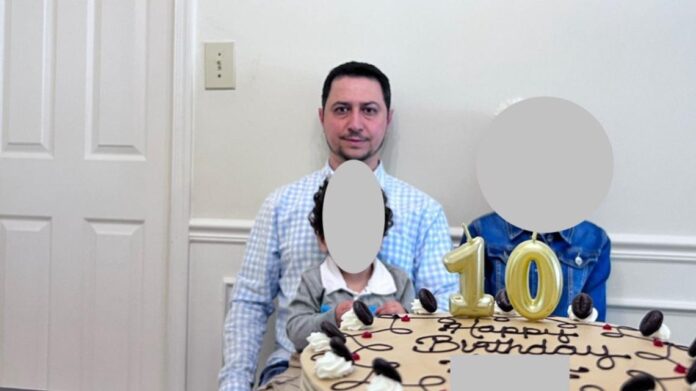
Aliyeh Hashemi asserts that her husband, Yousof Azizi, has never been affiliated with any terrorist organizations and was legally residing in the U.S. at the time of his arrest by ICE agents.
GERMANTOWN, Md. — The wife of a Germantown father detained by federal immigration agents is sharing her story with WUSA9, refuting the government’s claims against her husband and highlighting the emotional impact his detention has had on their two young children.
Yousof Azizi, a 40-year-old Iranian PhD candidate at Virginia Tech’s Arlington campus, was apprehended by Homeland Security Investigations agents on April 13 outside their Germantown, Maryland home. He is currently being held at an immigration detention facility in Arizona after being transferred from Maryland to Louisiana and then to Arizona—a process his wife says took nearly five days.
Aliyeh Hashemi, who also holds a PhD, chose not to appear on camera to safeguard her children’s privacy but agreed to respond to WUSA9’s questions in writing.
The Department of Homeland Security claims that Azizi misrepresented his past on his student visa application by denying any affiliation with Iran’s Student Basij Organization, a pro-government paramilitary group linked to the Islamic Revolutionary Guard Corps, which the U.S. classifies as a foreign terrorist organization. DHS further asserts that his student visa was revoked after he did not re-enroll at Virginia Tech for the Fall 2025 semester.
Hashemi categorically denies these allegations.
“This is not true,” she stated. “He has never been a member of Basij or any similar organization, either in Iran or the U.S.”
Regarding the visa issue, Hashemi explained that her husband had completed all necessary dissertation credits at Virginia Tech, but the university still required him to register for 12 credits each semester at international tuition rates, which the family could not afford. He sought to change his visa status from F-1 student to F-2 dependent, allowing him to register for just one credit per semester while finalizing his dissertation.
“His lawyer confirmed he was fully compliant with his status,” she wrote. “The real issue is that he voiced his opinions about the war. This visa situation is merely an excuse.”
A scholar, not an activist
Hashemi emphasizes that her husband’s appearances on BBC Persian and other media platforms stemmed from his academic pursuits rather than any political agenda.
“As he began his dissertation on U.S. presidential decision-making regarding other nations’ nuclear energy policies, particularly focusing on Iran, he became more prominent in academic circles,” she explained. “The media, especially Persian-language outlets outside Iran, started interviewing him. The topic of Iran’s nuclear program was highly relevant, and they sought his insights, as he was articulate and offered fresh scholarly perspectives.”
She notes that his message consistently advocated for building bridges between the two nations he cherished.
“Yousof viewed Iran as a land rich in science and culture and America as a hub of innovation and technology,” Hashemi wrote. “He loved both countries and believed that their relations should improve. In his interviews, he strived to promote dialogue over conflict.”
‘He thinks it is his father’
The most challenging aspect of Hashemi’s story involves their children—a 3-year-old son and an 11-year-old daughter, both born in the U.S. She was at home when agents arrested her husband in the parking lot, while the children were at school and daycare.
“My 3-year-old son, who is very attached to his father, is distressed and feels a profound sense of loss, though he doesn’t fully grasp what’s happening,” she shared. “At bedtime, he cries intensely—he was accustomed to sleeping next to his father. Whenever someone visits or the doorbell rings, he rushes to the door, thinking it might be his dad.”
Her 11-year-old daughter, she notes, often bursts into tears when she sees her little brother running to the door. Hashemi explained to her daughter that their father is in custody due to a “visa misunderstanding” and that lawyers are working to bring him home.
The couple has no family in the United States; Hashemi’s parents are in Iran, and a pending immigration application has prevented them from visiting for over a decade.
Hashemi mentioned that her husband managed to call her during his five-day transfer between facilities, and what he described was alarming.
“They are held in a cramped space with many others, most of whom are ill and coughing or sneezing,” she wrote. “He mentioned that two individuals even coughed up blood, which splattered onto the wall in front of them. At night, without mats, pillows, or blankets, everyone has to sleep on the cold stone or concrete floor.”
She added that the cold and illness left her husband unable to sleep for several nights, forcing him to walk around the small area just to stay warm.
‘Freedom of speech was real’
Hashemi reflects that the past week has compelled her to reevaluate her beliefs about the country where she and her husband chose to build their lives.
“We believed that the United States welcomed international students, professors, and scholars from around the world,” she wrote. “We believed that freedom of speech was genuine. We thought the U.S. was progressing toward its democratic ideals. However, as an academic family, we now see that this does not seem to be the case anymore. This incident has shattered the assumptions we held when we arrived in the U.S. thirteen years ago to further our studies.”
DHS states that Azizi will remain in ICE custody pending a hearing before an immigration judge and will receive full due process. WUSA9 reached out to DHS for comments on Hashemi’s claims but has not yet received a response.