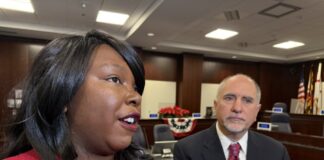

A recent 3-2 vote took place during a virtual meeting of the Governor’s Redistricting Advisory Commission, which was neither announced on the commission’s official website nor open to the public.
In a recent closed meeting, a panel appointed by Gov. Wes Moore (D) voted to move forward with plans for midcycle congressional redistricting, inviting public input on how to redraw the state’s eight congressional districts.
This 3-2 decision was made during a virtual session that lacked prior public notice and did not have an agenda posted on the Governor’s Redistricting Advisory Commission’s site. Senate President Bill Ferguson (D-Baltimore City) sharply criticized this approach in a statement, calling the outcome “predetermined” and pointing out the lack of public transparency.
The commission, under the leadership of Sen. Angela Alsobrooks (D-Md.), convened at 5 p.m. Shortly after 6 p.m., Moore’s office issued a statement in which Alsobrooks announced plans to solicit maps from the public and schedule two additional meetings.
“During today’s meeting, the Governor’s Redistricting Advisory Committee discussed the next steps and decided to continue our work on recommending a congressional map to the Governor and the General Assembly,” Alsobrooks stated.
“After Christmas, we will publicly share the submitted maps and conduct two additional meetings to gather feedback on the proposed options. Our process will remain open, transparent, and focused on ensuring that Maryland’s districts accurately represent our communities and comply with applicable laws,” she explained.
Joanne Antoine, executive director of Common Cause Maryland, expressed concern about the commission’s “glaring lack of transparency,” especially after the decision was made to move forward without providing any proposed maps to the public.
Critics Weigh In: ‘The Entire Process is a Mess’
The recent unannounced and unrecorded meeting of the Governor’s Redistricting Advisory Commission has raised red flags among open-government advocates regarding transparency and potential violations of the state’s Open Meetings Act.
“The commission has met five times already without releasing any proposed maps for public review, which raises significant concerns over their commitment to public engagement and transparency,” stated Joanne Antoine, the Executive Director of Common Cause Maryland. “Tonight’s private meeting may have violated Open Meetings Laws by failing to provide adequate public notice.”
Earlier meetings of the panel were held publicly and virtually, yet none involved maps for review by the public or the commission members. These meetings were often added last minute, without clarity on whether there would be in-person components, available maps for public comment, or a timeline for the process.
Nikki Tyree, executive director of the League of Women Voters of Maryland, remarked that the commission has not fulfilled the spirit or intent of open meetings laws. She accused the panel of prioritizing a single party’s interests over the needs of Maryland citizens.
“Today’s meeting went unannounced and was not available for public viewing,” Tyree asserted. “The commission has not shared upcoming meeting dates or a clear outline for public participation in developing fair maps. Although these may seem like small details, they clearly convey that the ruling party can push through its agenda while disregarding citizen input.”
The invitation from Sen. Angela Alsobrooks (D-Md.), chair of the redistricting commission, for public submissions of redistricting plans lacked specific instructions regarding formats or requirements. Interested individuals were simply encouraged to share their map ideas by emailing grac@maryland.gov.
Antoine raised concerns about the timeline for map submissions, which offers only a short window for proposals without known dates for the next meetings. “The entire process is disorganized,” she said.
A spokesperson for the governor’s office did not respond to queries regarding the private meeting.
“It’s unreasonable to ask voters for feedback without providing them any visibility into what they’re commenting on,” Antoine concluded. “This issue hinges on transparency; it’s about whether redistricting is conducted openly or in secrecy. The commission should immediately release any maps under consideration so the public can provide informed input, rather than expecting citizens to draft their own maps during the holiday season.”
The League of Women Voters of Maryland also expressed its discontent with the commission’s recent activities in a statement, emphasizing their concern over the lack of transparency surrounding the meeting and subsequent decisions.
Ensuring Fair Maps
Governor Moore established the five-member panel in early November, tasking it with ensuring that the congressional district maps validated in 2022 are “fair,” a term he has consistently avoided defining.
While Maryland Democrats possess a 2-1 advantage over Republicans in voter registration, they dominate the state’s congressional districts with a 7-1 majority: Rep. Andy Harris (R-1st) remains the sole Republican in Maryland’s congressional delegation, representing the 1st District, which covers the Eastern Shore and part of eastern Baltimore County.
In her statement, Alsobrooks emphasized Maryland’s obligation to proceed with redistricting.
“At a time when other states are aggressively redrawing maps, some even signaling intentions to weaken or nullify critical protections under the Voting Rights Act, Maryland cannot afford to be passive,” she remarked. “We must act so that the next Congress mirrors the will of the people and serves as a genuine check on the current Administration. This announcement is about engaging the public in our work and ensuring accuracy in the process.”
Julie Merz, Executive Director of the Democratic Congressional Campaign Committee, commended the Maryland commission for taking essential steps to ensure that the voices of Marylanders are heard amid national efforts by Donald Trump and his supporters to manipulate midterm elections through unprecedented mid-cycle redistricting initiatives.
Conversely, Republican leaders in both the House and Senate condemned the commission’s decision, with House Minority Leader Jason C. Buckel (R-Allegany) labeling it “the most corrupt process imaginable in an inherently corrupt endeavor.”
Ferguson Critiques the Commission Before Meeting
Just before the closed-door meeting commenced, Ferguson shared a statement claiming that “the outcome has already been predetermined. It is evident that the Commission’s decisions have been established since the announcement of the GRAB.”
Ferguson, one of the commission members, has been an outspoken critic of partisan mid-cycle redistricting efforts. He noted that public polling indicates that residents are more concerned about pressing issues than redistricting.
“The residents of our state have clearly expressed, both to this commission and through public surveys, that the majority do not support a new congressional map. They desire the government to concentrate on fostering economic growth, ensuring affordability, and providing real protections against this errant federal Administration,” he stated.
Members of the commission who participated in the meeting reported that the primary discussions involved whether to recommend proceeding with a redistricting proposal to the governor.
Cumberland Mayor Ray Morriss previously anticipated that the meeting would focus primarily on administrative matters, given that the commission had not presented any maps previously. If anything, he expected the meeting to center around planning future steps.
After the meeting, Morriss noted that while there were discussions on maps, none were actually presented to members.
“We talked about the types of maps we could create, who would design them, and whether we should organize more public hearings,” he described, revealing that he, along with Ferguson, voted against proceeding. “There was general agreement on the necessity of public involvement in drawing maps and conducting open hearings to allow the community to express their opinions.”
However, discussions also included the possibility of forwarding the matter to Moore and the legislature for public hearings.
“We debated whether to host hearings or submit directly to the General Assembly,” he added. “Ultimately, we decided that as a commission, we should invite public input on the maps under consideration.”
Others who attended the meeting perceived it merely as a “check-in.”
“I didn’t see it as anything significant,” commented Del. C.T. Wilson (D-Charles), a commission member who voted with the majority. “It felt more like a check-in to see if we are going to keep moving forward.” He noted that no policy discussions took place.
Wilson admitted he was not privy to the reasoning behind holding the meeting privately. Morriss shared after the meeting that he was surprised it wasn’t open to the public.
“I don’t believe we discussed anything that wouldn’t have been suitable for public access,” Morriss stated. “Initially, I assumed we would have attendees. It was only later that I realized it was a closed session.”
“I’m not a legal expert, but to me, it seemed like there was nothing to prevent a public audience in this discussion,” he added.
A ‘Predetermined’ Outcome
Ferguson stressed that he agreed to join the commission “to listen to the citizens of Maryland regarding mid-cycle redistricting. The collective oral and written feedback received thus far overwhelmingly indicates that the public opposes this initiative. Furthermore, our discussions lacked the depth needed for informed decision-making, which should have included insights from the Office of the Attorney General and local election boards.”
“Pushing ahead with a predetermined recommendation behind closed doors is reckless and lacks accountability,” he concluded.
Morriss concurred that the collected written and in-person testimonies suggested that Marylanders did not largely favor reshaping the congressional maps. While he pledged to keep an open mind, he noted the commission’s membership heavily influenced decisions.
“I wouldn’t go as far as to say anything is predetermined, but the composition of the commission does provide a clear indication of their inclinations,” he noted. “That bias has been evident since the start, and I have yet to see anything that signifies a shift in perspective.”
Morriss pointed out that the commission’s makeup and the timing of Moore’s recent statement, issued soon after their meeting, imply that it was carefully selected for a specific purpose.
Senate Minority Leader Stephen S. Hershey Jr. (R-Upper Shore) praised Ferguson for his statement ahead of the meeting, articulating the sentiment that many Marylanders have held since the beginning.
“People across Maryland understand this as a thinly veiled ploy to advance a political outcome decided behind closed doors,” Hershey stated. “Public hearings and commissions should serve as platforms for openness and trust, not performative exercises to validate predetermined outcomes.”
Hershey insisted that the commission should seek authentic input rather than just providing a façade for a political strategy already underway.
“I share President Ferguson’s belief that Marylanders deserve better,” he added, underscoring that when leaders from different factions arrive at the same viewpoint, it signifies a clear indication that the approach has missed the mark and that skepticism from the public is warranted.