
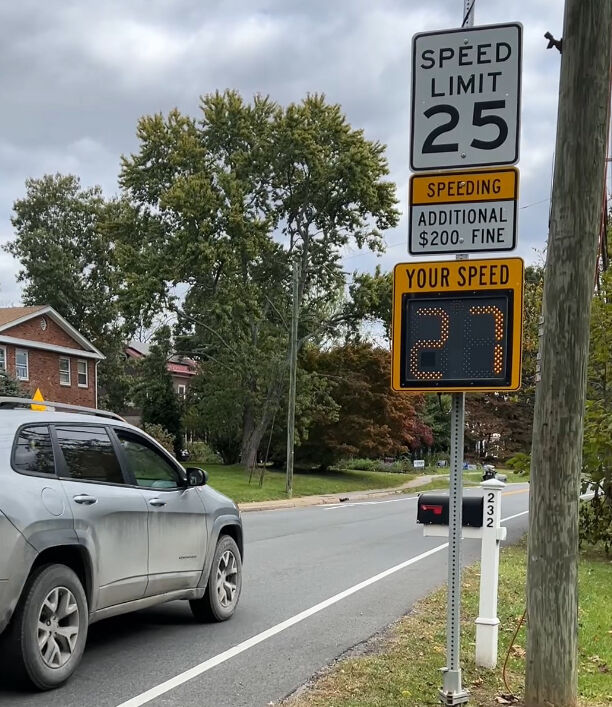
Currently, drivers from other states may receive tickets from speed cameras in Maryland, but enforcing payment has proven challenging.
Maryland legislators are set to evaluate new reciprocity agreements with neighboring states concerning speed camera infractions.
At present, out-of-state motorists can be ticketed by speed cameras while driving in Maryland, yet many of them often disregard these fines with little consequence. In fact, a significant number of individuals caught speeding in highway construction zones by these cameras have chosen to neglect their citations.
The extent of similar neglect regarding tickets issued by local counties and municipalities remains uncertain.
This situation may soon be subject to change.
A new proposal to be deliberated by state lawmakers in Annapolis, prompted by the governor’s office alongside the Maryland Department of Transportation, aims to enable the state to establish “reciprocity agreements” with other jurisdictions.
This new framework would mean that out-of-state drivers who speed past a camera and fail to pay their ticket could face complications with vehicle registration in their home state if Maryland successfully negotiates an agreement with that state.
Conversely, individuals who disregard speeding tickets from the District of Columbia may encounter comparable repercussions in Maryland. Leaders in D.C. have been advocating for this arrangement for several years.
“We do already have agreements with neighboring states regarding various traffic violations, such as speeding and other road offenses, specifically for citations issued by the Maryland State Police,” stated Joe McAndrew, the assistant secretary for project development and delivery at the Maryland Department of Transportation.
The only available information concerning unpaid tickets from speed cameras pertains to those utilized in highway work zones.
“Since 2010, we’ve recorded 770,000 unpaid citations for speed enforcement in work zones,” McAndrew mentioned. “Of those, 63% are attributed to vehicles from out of state.”
He acknowledged that discussions around potential reciprocity agreements have taken place with members of the D.C. Council.
“Our borders are quite open, and our roadways interconnect,” McAndrew remarked. “We want to ensure that the expectations we have for our residents in Maryland are reciprocated by those driving in D.C. or neighboring states.”
However, McAndrew emphasized that this initiative is not primarily about generating revenue, but rather focuses on enhancing safety, pointing to data that supports the notion that speed and stop sign cameras contribute to safer road conditions.
“Increased speeds lead to more severe roadway fatalities and serious accidents,” McAndrew stated. “By reducing speed, we significantly enhance the chances of preventing fatalities and minimizing property damage and injuries.”
In a statement to WTOP, D.C. Council member Charles Allen expressed optimism regarding this initiative as a “positive development.”
“I’m eager for greater collaboration across the DMV to ensure that reckless drivers are held accountable in Maryland, Virginia, and D.C.,” Allen noted. “We know that when enforcement is in place for speeding, drivers tend to operate more cautiously. Our data supports this. It’s a logical approach to improving road safety in our region.”
Allen chairs the District’s Committee on Transportation and the Environment.
While the governor’s office is advocating for this bill, the legislature has traditionally been cautious about swiftly expanding the powers associated with speed cameras. The Senate’s version of the proposed legislation has its first hearing scheduled for next week.