
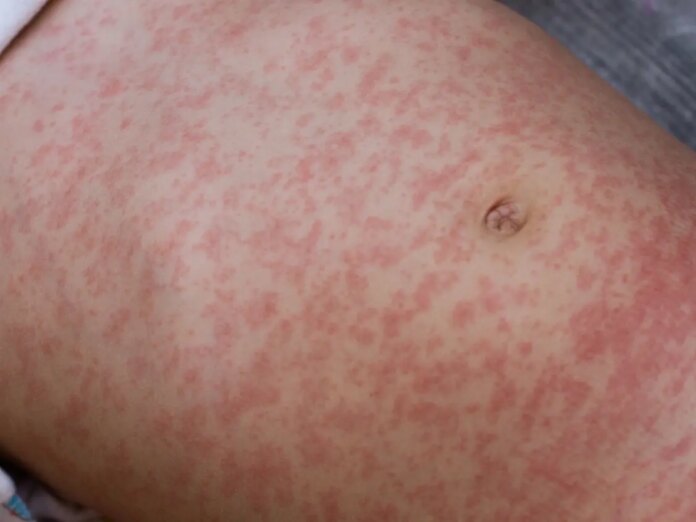
BALTIMORE, MD — A child diagnosed with measles traveled through Maryland, Washington, D.C., and Northern Virginia while contagious from late January 7 to early January 8, 2026, as reported by state health officials.
Measles is an extremely contagious illness that spreads easily through the air when an infected person breathes, coughs, or sneezes. It can also be transmitted via direct contact with infectious droplets.
The Maryland Department of Health has indicated that anyone who used the following public transport or spaces on January 7 and 8 may have been exposed:
- Amtrak NE Regional Train from Philadelphia’s 30th Street Station to Washington, DC Union Station on January 7 from 9:00 PM to 11:30 PM.
- Amtrak BWI Shuttle to and from the BWI train station and drop-off points outside the lower level of BWI Airport on January 7 from 10:45 PM to January 8 at 1:30 AM.
- BWI Airport Parking Shuttle to and from outside the lower level of BWI Airport and the long-term parking lots on January 7 from 11:00 PM to January 8 at 2:00 AM.
State health officials clarified in a news release that there was no exposure to measles within the terminals of Baltimore-Washington International Airport. Individuals who were not present in these locations during the specified times were not at risk of exposure in Maryland.
In a separate news release, the Virginia Department of Health identified the Alexander T. Augusta Military Medical Center Emergency Department and Executive Medicine Suite in Fort Belvoir as a potential site for measles exposure.
Anyone who visited this location on Friday between 9:30 AM to 3:00 PM and 10:00 PM to midnight may have been exposed, according to Virginia authorities.
The VDH described the patient as a “preschool-age child” who had “recently traveled internationally.”
What to Do If You Think You May Have Been Exposed
- Check your vaccination status for measles or if you have previously contracted the disease. Generally, if you received two doses of a measles-containing vaccine or were born before 1957, you are considered protected.
- If you are not fully vaccinated or immune and believe you may have been exposed, contact your healthcare provider or your local health department for guidance on the next steps. In Virginia, to verify your immunization status, call your healthcare provider or request records through the VDH Record Request Portal.
- Monitor for any early signs of measles for 21 days following your potential exposure.
- If you develop a fever or other measles symptoms, stay home and avoid childcare, school, work, or other public areas. Contact your healthcare provider first before visiting a waiting room or emergency department to prevent spreading measles to others.
- Be vigilant for symptoms of measles for 21 days post-exposure. This monitoring is especially crucial for those who are not fully vaccinated or immune. The most likely period for illness would be between January 16 and January 30.
Initial symptoms of measles include a fever exceeding 101 degrees, runny nose, cough, and red, watery eyes. Typically, one to four days after these early symptoms, a red rash will appear on the face and spread across the body. A person with measles is contagious from four days before the rash appears until four days after it begins.
“Vaccination is vital for safeguarding ourselves, our families, and our communities against measles and other infectious diseases,” stated Dr. Meg Sullivan, Deputy Secretary for Public Health Services at the Maryland Department of Health. “Situations like this highlight the importance of knowing your vaccination status and ensuring you are up to date with all recommended vaccines.”
Measles cases in Maryland are infrequent. No cases were reported in 2026, three in 2025, one in 2024, one in 2023, and none from 2020 to 2022.
As of now, Virginia has reported two measles cases in 2026. Any further exposure sites identified in Virginia will be updated on the VDH Measles website.