
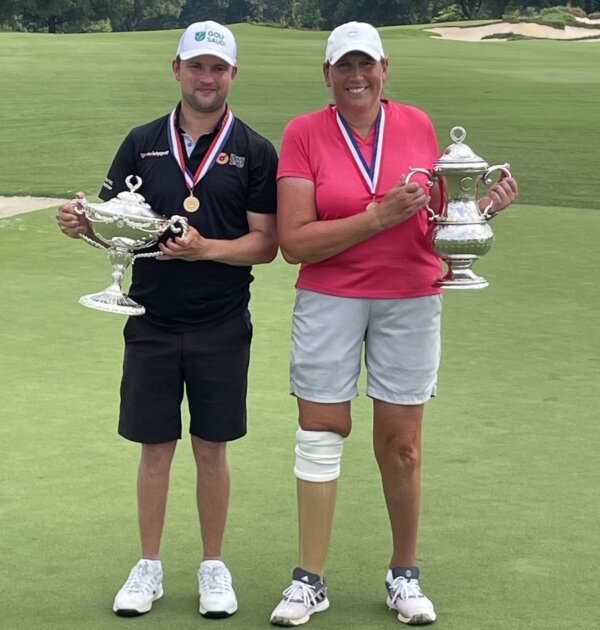
The U.S. Adaptive Open Championship, gaining recognition year after year, is organized by the United States Golf Association. It offers a competitive platform for golfers with physical, intellectual, and sensory impairments.
In an impressive show of skill, Kipp Popert and Kim Moore have both successfully defended their titles at the prestigious U.S. Adaptive Open Championship, held at Woodmont Country Club in Rockville, Maryland, for the second consecutive year.
The popularity of this tournament has soared, attracting considerable media attention, including coverage on the Golf Channel, and drawing enthusiastic crowds that followed the players throughout the course.
Ford Martin, a participant from Potomac who finished tied for 10th place after shooting an even par over three rounds, remarked on the exceptional talent displayed: “They’ll outperform your average club member at the course any day of the week.”
Now residing in Nashville, Martin expressed his excitement about the growing visibility of the event, noting, “The exposure that we’re receiving through Woodmont, the Golf Channel, and the USGA is nothing short of fantastic.”
Notably, Kipp Popert, hailing from England, completed the tournament with an impressive score of 18-under-par, successfully securing his status as a three-time defending champion.
In an interview with WTOP contributor Joe Yasharoff, Popert shared his optimism for the future of adaptive golf, stating, “For individuals with disabilities who are interested in getting into golf, the future looks promising.”
Reflecting on his own journey, Popert noted that the sport of disabled golf emerged for him at age 22, a late start that he hopes others won’t experience. He has undergone several surgeries due to cerebral palsy, but credits the game with significantly boosting his confidence. “If I had access to disabled golf when I was a child, it would have been a game-changer for me,” he shared.
The women’s champion, Kim Moore from Fort Wayne, Indiana, showcased her exceptional talent by winning with a six-stroke lead, having shot three rounds of 76.
“Just look at everyone here,” Moore exclaimed, highlighting the vibrant atmosphere of the tournament. “We enjoyed three hours of live coverage on the Golf Channel, with all players giving it their utmost effort.”
Moore, who was born without a right foot and competes with a prosthetic, carries a motivational message for aspiring golfers: “The key is to give it a try. Come out and take a chance, and you might be surprised by the outcomes.”
She elaborated on the commitment required to excel in golf, stating, “Achieving proficiency in this sport demands effort and dedication. It is an adaptable game, and one that everyone can participate in. Just step off the sidelines, give it a go, and you may find yourself enjoying a round at a course like Woodmont.”
The USGA also recognized various players for their achievements in specific categories:
- Coordination Impairment: Bailey Bish, Tucson, Arizona (women); Kipp Popert, England (men)
- Intellectual Impairment: Sunyoung Kim, Republic of Korea (women); Simon Lee, Republic of Korea (men)
- Lower Limb Impairment: Kim Moore, Fort Wayne, Indiana (women); Lachlan Wood, Australia (men)
- Multiple Limb Amputee: Rose Veldman, Los Angeles, California (women); Jordan Thomas, Nashville, Tennessee (men)
- Seated Players: Annie Hayes, Lee, Massachusetts (women); Max Togisala, Ogden, Utah (men)
- Short Stature: Brendan Lawlor, Ireland (men)
- Upper Limb Impairment: Sophia Howard, Hudsonville, Michigan (women); Justin Carlock, Eaton, Colorado (men)
- Vision Impairment: Amanda Cunha, Kaneohe, Hawaii (women); Kiefer Jones, Canada (men)