

Astronomers have identified a potential new dwarf planet in the solar system, located beyond Pluto’s orbit, which has been tentatively named ED138.
Check out the orbital pathway of the new dwarf planet candidate in the video above
Should subsequent observations validate this discovery, ED138 could become part of the select group of five currently recognized dwarf planets by the International Astronomical Union (IAU): Ceres, Pluto, Haumea, Makemake, and Eris.
The discovery was made possible by the Vera C. Rubin Observatory, a sophisticated telescope situated on a mountain of 2,682 meters (8,800 feet) in Chile, which hosts the world’s most advanced digital camera. This telescope began its operations in 2025 and has the capability to capture images of the entire sky every three days.
Matthew Holman, a senior astrophysicist at the Smithsonian and an astronomy lecturer at Harvard University, utilized a computer program he co-developed to analyze data gathered by the Rubin Observatory earlier in 2026, with the aim of scanning billions of moving objects. Upon detecting ED138, Holman experienced an initial reaction of “excited disbelief” and promptly verified the result to rule out any potential errors.
To confirm the findings, Holman collaborated with his colleague Mario Jurić, the lead scientist for the Solar System at Rubin and a professor at the University of Washington. Jurić investigated Rubin’s catalog for additional sightings of ED138 and uncovered 20 more observations dating back to March 2026. Utilizing various data sources, the researchers were able to trace the object’s orbital path as far back as ten years.
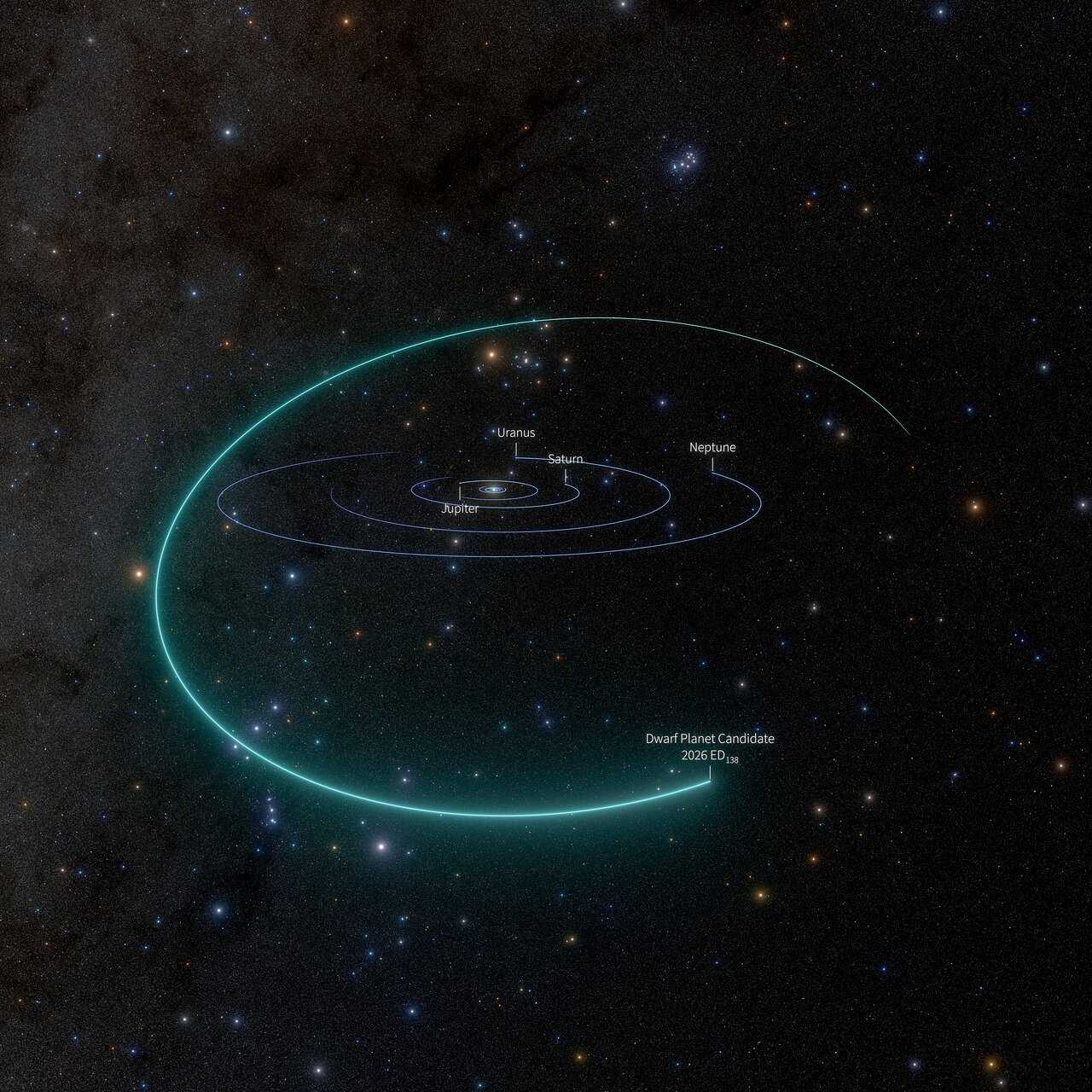
NSF–DOE Vera C. Rubin Observatory/NOIRLab/SLAC/AURA/R. Proctor
This image illustrates the orbital path of the newly discovered dwarf planet candidate ED138 within the Solar System.
However, Holman cautions that ED138 has yet to be officially classified as a dwarf planet: “At this stage, it remains a candidate. Determining its physical size is essential, and that will likely take several months.”
Introduction to ED138
The estimated diameter of ED138 ranges from 600 to 1,500 kilometers (approximately 370 to 930 miles), a size that surpasses that of the smallest known dwarf planet, Ceres. Its current orbit places it at a distance of about 46 astronomical units from the sun, meaning it is located farther from the sun than Pluto and falls into the category of trans-Neptunian objects (TNOs) — celestial bodies that orbit the sun at distances greater than that of Neptune.
Though ED138 is too faint to be seen with the naked eye in the night sky, Holman notes that “it is bright enough for discerning amateur astronomers to spot it if they are aware of its location.”
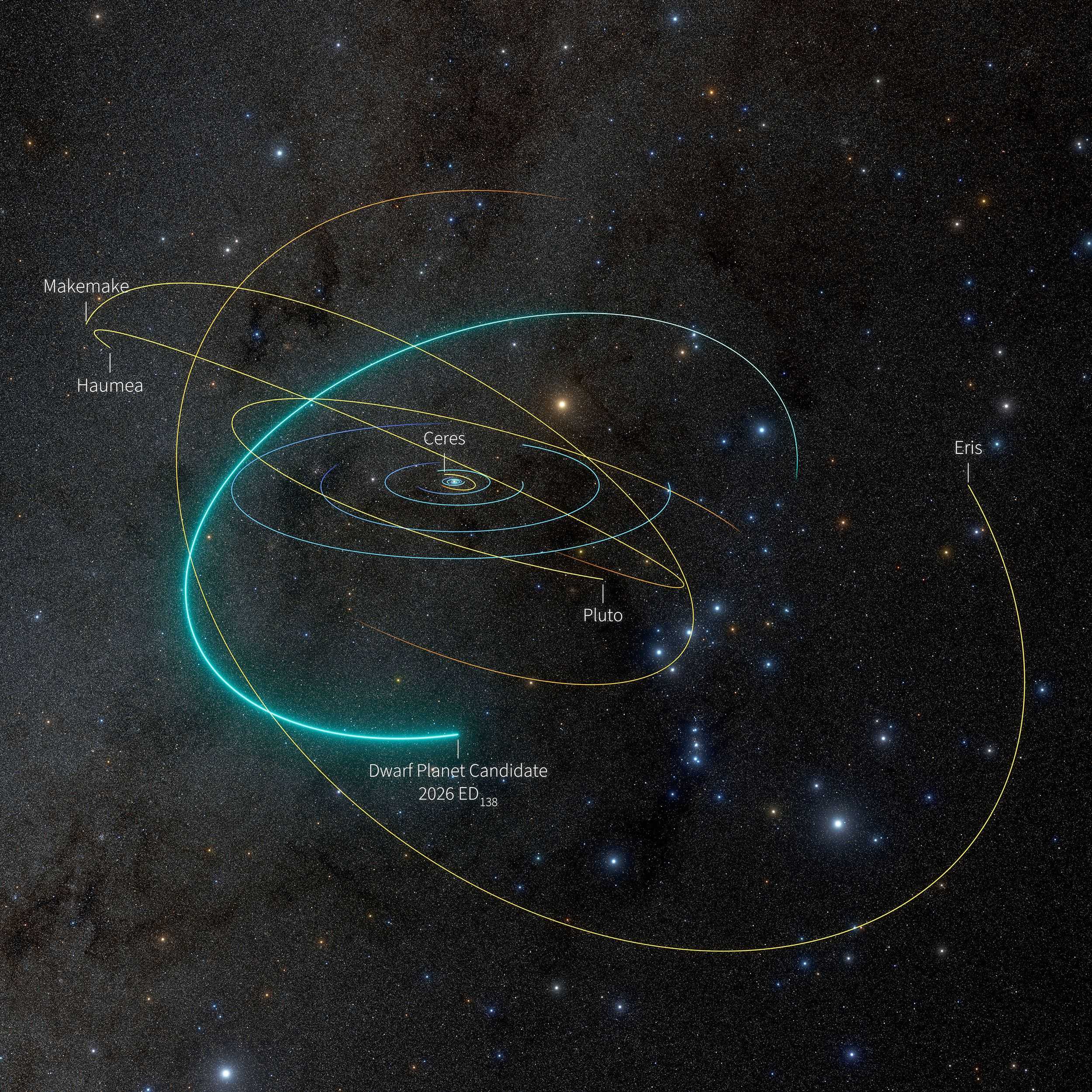
NSF–DOE Vera C. Rubin Observatory/NOIRLab/SLAC/AURA/R. Proctor
This image depicts the orbital trajectory of ED138 juxtaposed with the five dwarf planets.
One reason why scientists had not previously detected ED138 is its position in the southern hemisphere, making it particularly challenging to observe from the northern hemisphere, Holman pointed out.
“This limitation excludes many telescopes that might have otherwise spotted it, and there are significantly fewer telescopes monitoring the southern sky,” he added.
Additionally, the object’s orbit is nearly aligned with the plane of our galaxy. “For two decades, this object has been moving through the Milky Way from our vantage point,” Holman explained. “Typically, astronomers do not search for objects in the Milky Way due to the sheer number of stars, which makes identifying moving bodies particularly difficult.”
ED138 is just one of many objects recently identified by the Rubin telescope, which has amassed discoveries predominantly of asteroids and smaller trans-Neptunian objects. According to Holman, there may be “a handful” of additional objects comparable in size to ED138, and the Rubin Observatory is expected to find those as well.

NSF–DOE Vera C. Rubin Observatory/NOIRLab/SLAC/AURA
The orbital trajectory of the newly discovered dwarf planet candidate, ED138, as recorded by the Vera C. Rubin Observatory.
“The Rubin Observatory is effectively performing its role well, executing a deep survey of the Solar System,” stated Megan Schwamb, a reader in astrophysics at Queen’s University Belfast and a member of the Rubin Solar System Operations team, via email.
“I was amazed that such an object was found so soon after the observatory’s initial commissioning phase. This was not something I anticipated for this year,” Schwamb added. “It highlights how the Rubin’s rapid pace, depth of coverage, and extensive sky coverage will reshape our understanding of the Solar System over the next decade, particularly in the immediate future.”
‘Perceive it as a world’
In 2006, the IAU established a new definition of a planet designating it as an object that orbits the sun, possesses a mostly spherical shape, and is sufficiently large to have cleared its orbital path of comparable-sized objects. This definition led to the controversial demotion of Pluto as it failed to meet the final criterion, reducing the count of recognized planets in our solar system from nine to eight.
Concurrently, Pluto and others like it came to be classified as dwarf planets — objects that are nearly round and orbit the sun, yet lack the mass to clear their orbital paths of debris.
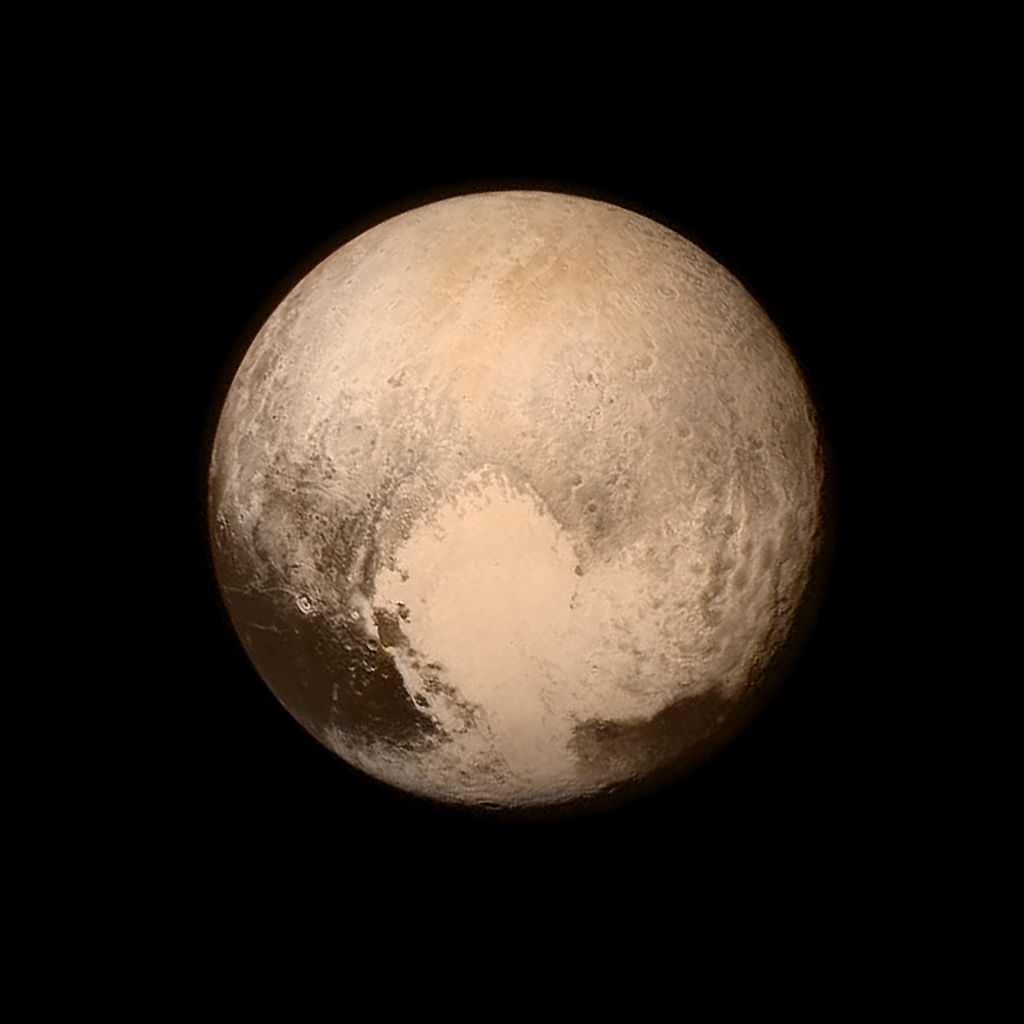
NASA
This stunning image of Pluto, captured by NASA’s New Horizons spacecraft on July 13, 2015, showcases the dwarf planet nearly filling the frame while the spacecraft was positioned 476,000 miles away.
If ED138 is ultimately confirmed as a dwarf planet, astronomers will assign it a permanent numerical designation, followed by the allocation of an official name. This process may take time, and the specific individuals responsible for selecting the name remain undetermined.
“I have received various name suggestions via email, some of which are already in use by other celestial objects,” said Holman. “I’m unsure of the outcome. It will be an exciting process, but it’s a massive undertaking, so I’m not expecting to be involved in the naming directly.”
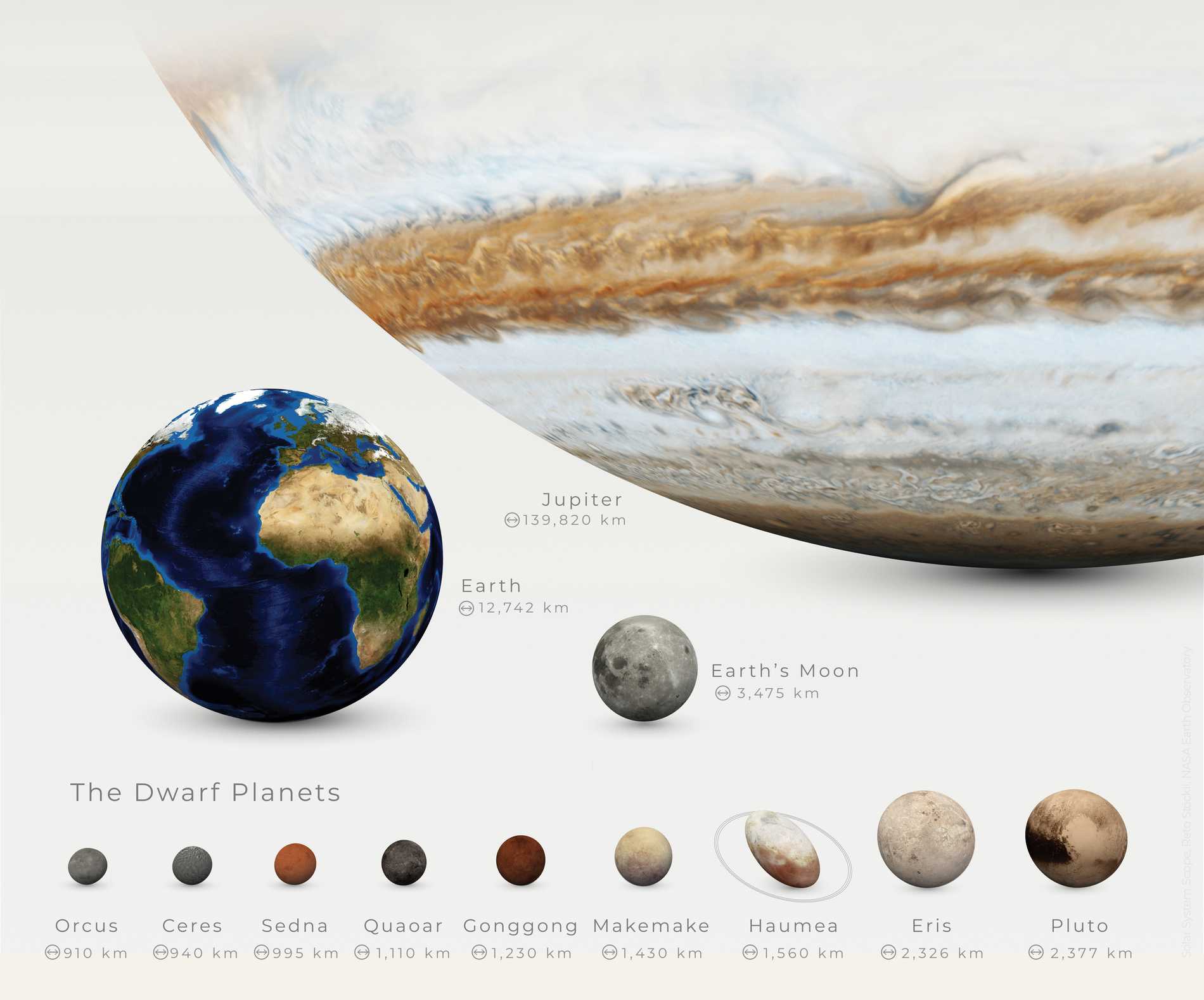
VISUAL CAPITALIST/SCIENCE PHOTO LIBRARY
An illustration showcasing the five recognized dwarf planets of the solar system alongside several smaller celestial bodies.
The implication of this discovery holds considerable importance within the scientific community, remarked Michele Bannister, an associate professor at the University of Canterbury in New Zealand, who was not part of the discovery team.
The significance lies in the fact that it is a trans-Neptunian object and possesses considerable size, yet remains relatively dim compared to what can be perceived with the naked eye, said Bannister, a specialist in the study of smaller celestial bodies within our solar system.

NSF–DOE Vera C. Rubin Observatory/NOIRLab/SLAC/AURA
A detailed mosaic assembled from images taken at the Vera C. Rubin Observatory, showcasing the newly identified dwarf planet candidate.
Bannister emphasized that the size of ED138 is now significant enough that it may be considered a world, and as other telescopes take further investigations, we may uncover more about its characteristics.
“If we were to send a spacecraft there, perhaps we would discover features similar to the nitrogen glaciers found on Pluto,” Bannister speculated. “However, until we gain more knowledge about it, we can only make educated guesses regarding its physical attributes.”