
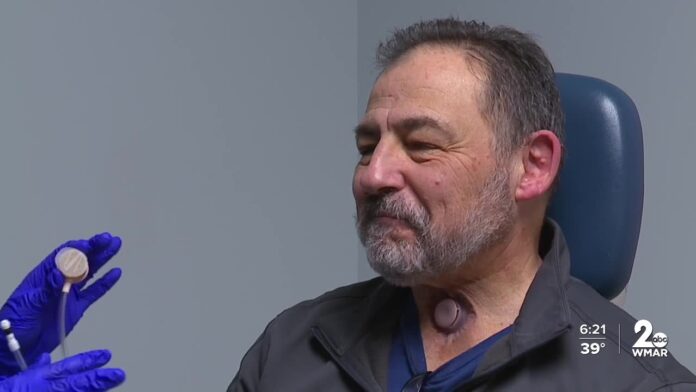
TOWSON, Md. — After triumphing over stage three throat cancer in 2012, Steve Navaroli believed his challenges were behind him. However, six years later, he encountered an unforeseen complication that necessitated a significant life choice.
During his initial battle against cancer, Navaroli underwent an intense regimen that included 33 radiation sessions, weekly rounds of chemotherapy, and surgery to relocate his salivary gland.
“That salivary gland transfer was a game-changer for me; it brought me back to nearly normal,” Navaroli shared.
After being declared cancer-free, he returned to his previously established routine. Yet, approximately six years later, he began to experience concerning symptoms during his daily walks.
“I enjoy walking, but I noticed that I was getting winded much more easily,” Navaroli recalled.
The radiation that saved his life ended up causing severe scarring on his vocal cords. Dr. Bushra Lohrasbi, a specialist in head and neck speech-language pathology at GBMC, explained that the effects of radiation therapy can sometimes emerge years later.
“Steve’s case was particularly notable because his vocal cord cancer occurred at least a decade ago. While radiation was life-saving, it often continues to have implications long after treatment,” Lohrasbi said. “He’s now faced with limitations in one or more of the categories critical to vocal function—speaking, breathing, and swallowing.”
Navaroli was faced with a tough decision: to undergo a tracheotomy that could preserve his voice box or opt for a laryngectomy to eliminate it entirely. After thorough deliberation, he chose the laryngectomy, a choice that ultimately saved his life.
“The doctors informed me that when they removed my vocal cords, they discovered spots that would have otherwise gone unnoticed,” Navaroli explained.
Now, seven months post-surgery, Navaroli communicates through a stoma in his neck, using a device that grants him a voice resembling his former one. Additionally, he enjoys improved breathing, something he hadn’t experienced in years.
“Advancements in research and technology in our field, as well as in biomechanical engineering and medical devices, have made incredible progress. We’re fortunate to be involved at the Dan Center, taking part in clinical trials for new AI products, ensuring our patients have access to the latest innovations,” Lohrasbi remarked.
Navaroli expresses his gratitude towards the team at the Milton J. Dance Center at Greater Baltimore Medical Center for restoring his quality of life.
“Removing someone’s voice box doesn’t mean we’re stripping away their ability to communicate,” Lohrasbi emphasized.
The Dance Center at GBMC continues to explore cutting-edge voice prosthesis technologies, including hands-free devices, aiming to enhance patient care and support a return to a normal lifestyle.
“This story was shared by our news team and adapted for this platform with the help of AI. Our editorial crew reviews all content across platforms to ensure accuracy and fairness.”