
Having spent years honing his craft as a writer and storyteller, John Waters is always prepared with engaging talks for any occasion.
During the festive season, he shares insights on navigating holiday pressures. On Valentine’s Day, his humorous tips on romance take center stage. Last year, around the time he celebrated his birthday, he focused on how to dodge the pitfalls of aging, famously cautioning against becoming an “old fart.”
On Thursday evening, Waters took the stage to welcome a packed ballroom of aspiring writers and educators at one of America’s largest literary events, offering them precisely what they needed: valuable insights on how to thrive as a writer and recognize when they’re making progress.
“For a writer’s career to truly take off, someone other than your mother or your romantic partner needs to notice your work,” he instructed the audience. “Your writing journey truly begins when you have a third reader.”
Waters served as the keynote speaker for the 2026 AWP Conference and Bookfair, a significant event that attracted around 10,000 participants to Baltimore from March 4 to 7.
Described as a pivotal gathering for literary enthusiasts in the U.S., the conference is a weekend filled with opportunities for networking and learning. Waters’ presentation was supported by Johns Hopkins University, which is celebrating its 150th anniversary this year and boasts the second oldest degree-granting creative writing program in the country. A Baltimore native, Waters is also known for directing numerous films, including classics like “Hairspray” and “Pink Flamingos,” along with authoring ten books.
Addressing hundreds of attendees in the Baltimore Convention Center’s most expansive ballroom, Waters delivered a dynamic spoken-word performance, tailored specifically for the audience of writers and educators. True to his nature as the author of a book aptly titled “Mr. Know-It-All: The Tarnished Wisdom of a Filth Elder,” his speech intertwined humorous personal stories with essential writing advice, referring to the audience as “the toughest crowd of all.”
At the age of 79, Waters began his presentation by reflecting on his journey as a storyteller. He openly admitted that, unlike many children, he didn’t develop a keen interest in reading at a young age. Upon entering school, he encountered what he termed “the enemy of reading”: book reports.
Waters shared that he wasn’t captivated by tales of Benjamin Franklin and his kite—instead, he wished to read about hot rods, even lamenting that the “mind-numbing educators” of his youth failed to offer such literature. He expressed the view that schools should allow children the freedom to choose any book they desire. “If a 14-year-old wants to read the Marquis de Sade, they are old enough to handle it,” he asserted. “If a young girl prefers ‘Story of O’ over ‘Little Women,’ that should be her right.”
He humorously noted that Life Magazine “corrupted” him early on by exposing him to complex subjects like homosexuality and addiction. At 11, he wrote his first puppet show and had a decent career entertaining children at birthday parties—until a shoe mishap involving a stepsister from Cinderella led to his downfall.
From his early experiences as a writer and performer, he recognized writing as a powerful tool: a means to incite laughter, provoke thought, and even earn a living. While working as a junior camp counselor, he crafted a horror story that frightened some campers, drawing warnings from his parents about his vivid imagination.
“The concerns made me feel strangely validated,” Waters remarked. “I suddenly found myself controversial and I reveled in it.”
In high school, he became a “loud-mouth troublemaker,” frequently jesting and poking fun at religion. His reading list evolved to include authors like William S. Burroughs and Jean Genet, nurturing visions of his future. “I wanted to be filthy,” he declared. “I aspired to be a nutty intellectual who could make people laugh.”
Waters reminisced about his first published work—a letter to the editor of Life Magazine in 1962 defending Andy Warhol’s contributions. “A great exercise for young students would be to see who could get a letter published first,” he suggested playfully.
His first paid writing gig came soon after, when he received $100 for an article titled “Inside an Unwed Mother’s Home” for Fact magazine, a piece he admitted was entirely fabricated.
This led him into the realm of underground cinema, kickstarting his dual career as a writer and director. “Every movie I made was first a written piece; I wouldn’t have it any other way,” he stated confidently.
Here are some key insights from Waters’ nearly 40-minute keynote address:
- Read voraciously: With a personal collection of 13,546 books, Waters is passionate about reading. He even collects adult-themed parody versions of classic titles, displaying them alongside their originals, featuring titles like “Some Like it Hard” and “Clitty Clitty Bang Bang.”
- No bathroom humor: Despite his famously scatological reputation, he refrains from collecting books centered around toilet humor, although he humorously contemplated a title—”Wiping Issues: You’re Not Alone.”
- Not a TV buff: Waters enjoys appearing on television but confessed, “I don’t even know how to turn my TV on; it’s just too complicated for me.”
- On politics: He pointed out that Donald Trump’s most scandalous offense was the dismissal of Carla Hayden as Librarian of Congress.
- Script writing essentials: He shared insight that the first ten pages of a screenplay are what attracts studio executives, while the final ten pages symbolize potential box-office success.
- Edit with precision: “No comedy should exceed 90 minutes,” he claimed, adding, “There’s no such thing as a lengthy joke.”
- Be versatile: Known for his diverse styles, Waters noted that he never repeats himself across his various creative projects—from horror to musicals and dance-themed films.
- Drug influences: He candidly shared that his creative process began with pot, stating, “I always smoked before writing… though we weren’t on drugs during film production.” He later stepped away from drugs after achieving some level of success.
- Consistency in writing: Waters emphasized his daily writing routine, claiming, “My job is to generate bizarre ideas in the morning and sell them in the afternoon.”
- Morning rituals: “I wake up at 6 a.m., check my phone, and take a bath since showers feel too abrupt.”
- Maintain discipline: Writing must commence precisely at 8 a.m. “Not a minute before or after,” he insisted. “Once you have your first draft, re-read it, and you may be surprised at your own creation. That’s when the real rewriting begins.”
- No social media presence: Waters questioned why a writer would give away content on platforms like Instagram, pondering, “What incentive would there be for readers to buy my books if they saw everything for free online?”
- Editing advice: “If you feel something should be cut, it should be,” he suggested. “When you return something you’ve edited, it’s usually the final mark of completion.”
- Stay observant: “When you’re not writing, you’re still creating,” he pointed out. “I draw inspiration from observing people daily and eavesdropping on conversations. A writer should never feel bored.”
- Get your book banned: “If only you were that fortunate, your book would be prominently displayed as a forbidden read, not shoved in the back of a bookstore,” he joked.
Without a Q&A session and steering clear of political topics, Waters wrapped up his talk without elaborating on his recently announced role in Season 13 of American Horror Story, with filming set to kick off in early April.
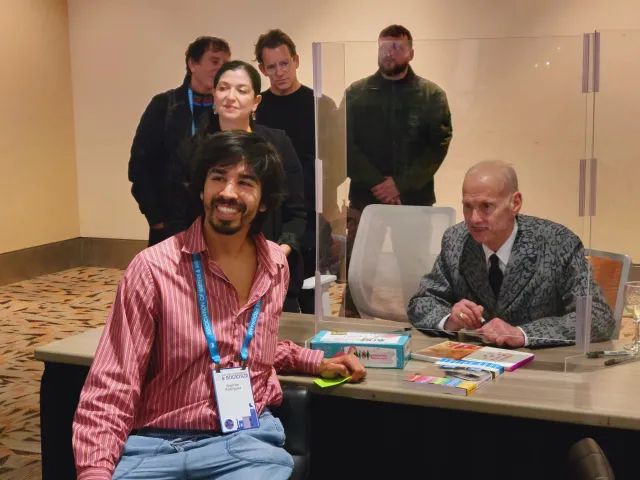
After concluding his address, Waters took part in a book signing hosted by Atomic Books, where he patiently greeted fans until 11:30 p.m., signing copies and posing for photographs. The line for his signing was reminiscent of the waits he typically draws at Atomic Books.
The AWP Conference and Bookfair continues on Saturday, with activities taking place at the Convention Center and other locations throughout Baltimore.