
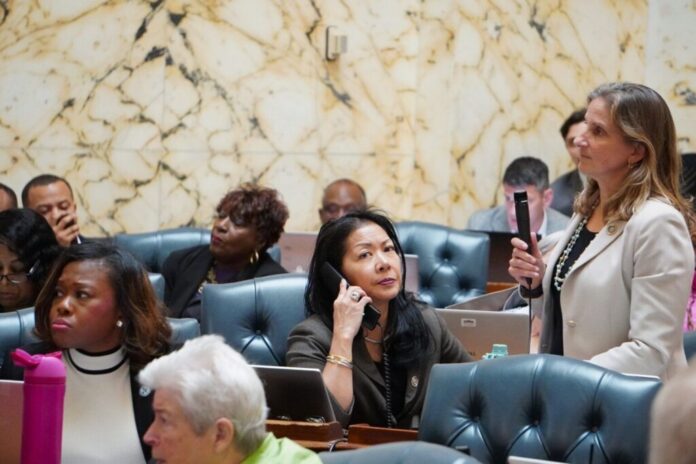
The Maryland House of Delegates approved two Republican amendments to a bill, one of which introduces an additional “good cause” for landlords to refuse lease renewals with tenants.
This article was republished with permission from WTOP’s news partners at Maryland Matters. Sign up for Maryland Matters’ free email subscription today.
The legislation concerning “Good Cause Evictions,” aimed at safeguarding tenants from unjust eviction, witnessed renewed discussions on Friday. Delegates engaged in about 90 minutes of debate on a bill that had previously seemed doomed just days prior.
This extensive debate yielded significant outcomes, with the House adopting two amendments proposed by the Republican party. The first amendment adds an additional “good cause” for landlords wishing to terminate a lease. The second amendment excludes short-term rental properties from the legislation’s scope.
However, nine Republican amendments that sought to make the bill more advantageous for landlords, thereby undermining renter protections, were rejected by the House.
The bill is anticipated to receive final approval from the House early next week before it moves to the Senate, where similar proposals have faced challenges for the past several years.
House Bill 774, championed by Del. Jheanelle K. Wilkins (D-Montgomery), represents the latest iteration of legislation often referred to as “just cause evictions.” This legislation permits local jurisdictions to mandate that landlords provide a reason from a designated list when choosing to cancel a lease.
Potential reasons outlined in the bill may include failure to pay rent, engaging in disorderly conduct, or violating the lease—among other infractions.
Del. Chris Tomlinson (R-Frederick and Carroll) proposed an amendment to add scenarios where a tenant’s lease is contingent upon employment to the “good cause” list.
“It’s common for landlords to employ a property manager, resident manager, or maintenance worker, and frequently this employment comes with housing as part of the job,” Tomlinson noted. “Therefore, I believe it’s reasonable to state that if the job ends, the landlord shouldn’t be obligated to renew the lease automatically.”
Del. Lorig Charkoudian (D-Montgomery), who guided the floor discussions, accepted this amendment as friendly—a relatively rare occurrence for Republican contributions in a Democratic-controlled House.
Charkoudian also agreed to accept Del. Steven J. Arentz’s (R-Upper Shore) amendment to exempt short-term rentals from the bill, emphasizing that the language regarding companies like Vrbo or Airbnb was unclear.
However, friendly amendments ceased there. Proposals like requiring tenants to cover attorneys’ fees if they lost a good cause claim and exempting active military landlords from the bill were among those that were rejected.
Charkoudian emphasized that the purpose of the legislation is to protect families from unjust evictions, suggesting that diluting these protections would defeat the bill’s intention.
“This is enabling legislation. If we pass this law, each county must choose to implement it locally,” Charkoudian stated. “The aim of this bill is to ensure that if a family is facing eviction, there must be a legitimate reason for it.”
Following the debate, the House granted preliminary approval to the amended bill, with a final vote expected early next week. Nonetheless, House Minority Leader Jason C. Buckel (R-Allegany) mentioned that Republicans are still prepared to vocally oppose the bill during its final vote.
“This is an unconventional bill,” Buckel remarked after the evening session. “It faces substantial opposition and is a result of a unique committee process.”
This legislation made a comeback this week after being initially voted down by the Economic Matters committee on Monday.
When Economic Matters Chair Kriselda Valderrama (D-Prince George’s) called for a vote on HB 774 that day, it failed to pass—with only nine out of twenty delegates supporting it while seven opposed and three were absent.
On Wednesday, Del. Veronica Turner (D-Prince George’s), who had opposed the bill earlier, requested a reconsideration. She switched her stance, voting alongside ten others in favor, while two opposed, one was excused, and six were absent, including several Republicans who departed during discussions.
“It was brought back, and people quite unexpectedly changed their minds within just 36 hours,” said Buckel.
This favorable vote on Wednesday allowed the bill to be presented on Friday for further consideration by the full House, where many anticipate it will pass.
The House had approved similar legislation in 2024 with a vote tally of 96-7, but that bill ultimately stalled in the Senate Judicial Proceedings Committee.
Last year, Judicial Proceedings attempted to amend the bill, asking local jurisdictions to choose between rent-control measures or good cause evictions in an effort to strike a balance between developer interests and renter needs. However, advocates withdrew their support for the modified measure, leading to its demise in committee once again.
Even if the House ultimately approves HB 774, it is likely to confront similar obstacles in the Senate, especially with just over a week remaining in the 2026 legislative session.
“I would speculate that the bill doesn’t have a favorable outlook in the Senate,” Buckel concluded.