
Written by Susan Soderberg of the Germantown Historical Society
Have you ever thought about the history of the land where Germantown Town Center now stands, particularly near the Germantown Library or BlackRock Center for the Arts?
The area now known as Germantown has a rich history that dates back thousands of years. Evidence suggests that indigenous peoples inhabited this land during the Ice Age, around 10,000 years ago, when the climate was significantly colder and glaciers extended into parts of present-day Pennsylvania. These early inhabitants primarily settled along the Potomac River, a trend that continued with the Woodland peoples who lived here between 1,000 to 2,000 years ago.
When European settlers arrived in the late 1700s, the Piscataway tribe was the primary native group in the region, occupying land from the mouth of Rock Creek to the Monocacy River. A notable Rock Shelter used by the Piscataway can still be found near Black Rock Mill in Germantown. By the time Europeans established their presence, most native inhabitants had disappeared from the area.
Unlike today’s numbered properties, early settlers named their land. The Town Center now sits on parcels known as “Bachelor’s Choice,” “New Found Land,” and “Well Paid For.” Until the mid-1800s, this land was largely untouched, consisting of native forests or larger tracts owned by the Waters family, who cultivated wheat, corn, and flax.
The completion of Germantown Road (Route 118) in the 1840s led to the division of land into smaller farms. However, maps from 1865 and 1879 indicate that the area where the Town Center is located remained largely unoccupied, likely due to its swampy conditions during wet weather, attributed to numerous springs in the vicinity.
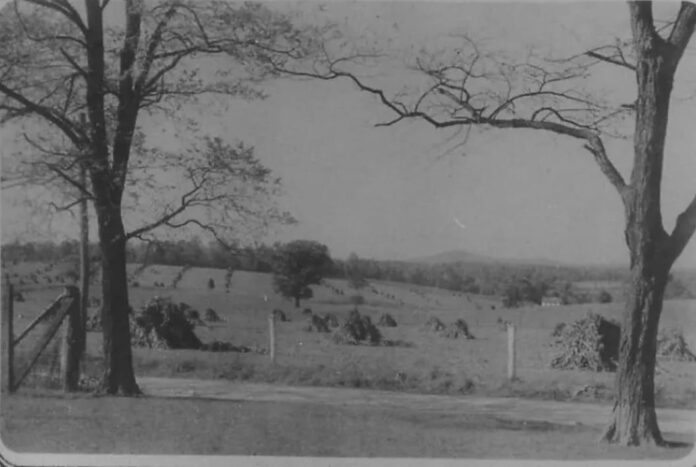
By the late 19th and early 20th centuries, two farms were established on this land: one owned by Mr. Appleby and the other by Mr. Hickerson. Henry C. Hickerson, who moved to Germantown from Virginia in 1857 as a school teacher, purchased 185 acres where the Town Center currently sits. He farmed the land with his children, who later continued the family farming tradition.
The Applebys, known as the town’s carpenters and undertakers, operated their businesses near the Germantown train station, about a mile from their farm. In those days, carpenters often built coffins, merging their trades. The Appleby farmhouse is now the site of EuroMotors.
Although the arrival of the train in the 1870s spurred some growth around the station, Germantown truly began to develop in the 1970s after the completion of I-270 (originally called 70-S) and the installation of a new sewer line. This period saw an influx of about 2,000 residents annually, along with the establishment of shopping centers, local businesses, schools, and recreational fields.
Reflecting on a century ago, Germantown was a quieter farming community where families prioritized raising children and maintaining vegetable gardens and chickens, even in town. The focus was more on sustaining a livelihood than on accumulating wealth, fostering a strong sense of family and community.